Rare SE20 chair manufactured by ’t Spectrum Bergeyk 1980s. This late experimental Visser design from 1988 was only manufactured as a very limited production (20 or so?) making it a real collector or museum piece and prime example of Dutch postmodern design. It was manufactured in various colourways – this chair is a vibrant cobalt blue.
In superb hardly used condition.
See: Boijmans Museum collection / literature: ‘tSpectrum Moderne meubelvormgeving en naoorlogs idealisme. Uitgeverij 010, Rotterdam 2002.
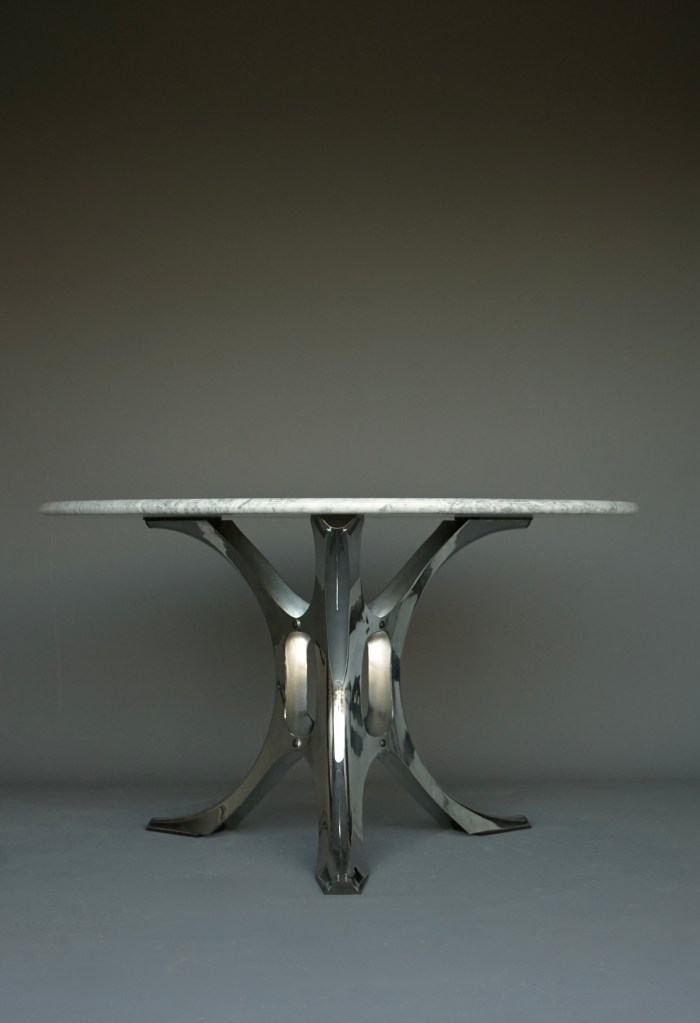
The bumper table is undoubtedly Martin Visser’s most intriguing design, the baroque translation from 1965 of his table base tz06 from the early 1960s. The development of Martin Visser’s bumper table provides insight into and understanding of his design processes: The table’s main feature is its reversible tripod base, later called ‘Abusir’ – Seemingly simple with the three points on the floor and three points to carry the top (in the history of furniture the tripod table is known to be the most stable structure).
Only two series were produced in very limited numbers due to the technical difficulties of manufacturing the base. Spectrum Furniture (‘t Spectrum) manufactured the table as several versions that varied in height, width, materials and finishes – this version with the white carrara marble top.
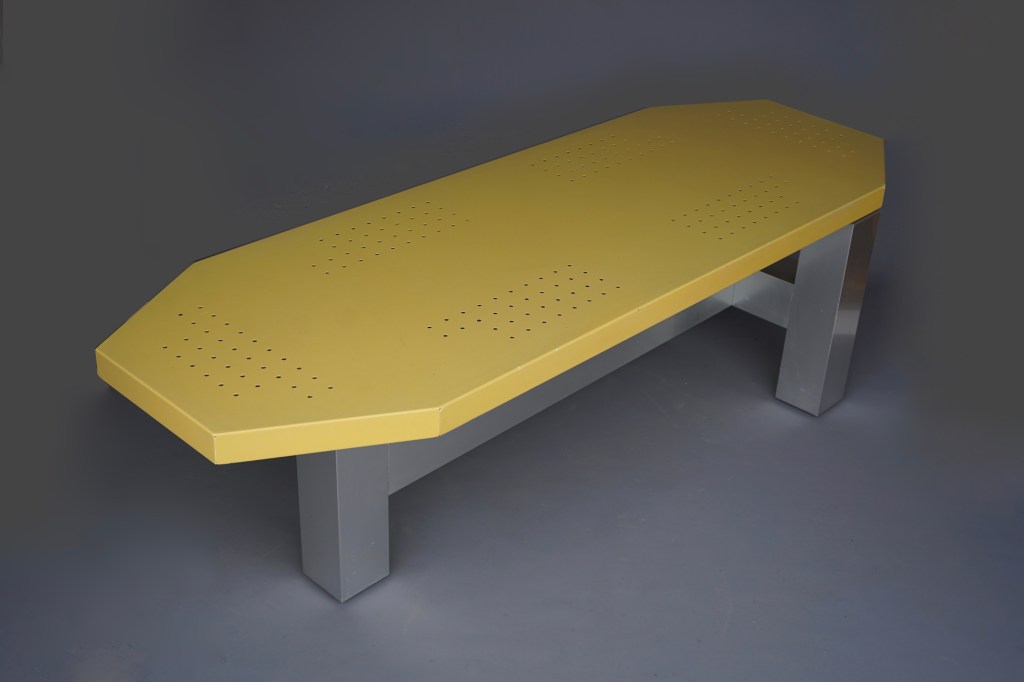
Enamelled steel and aluminium. 244 x 85 x 75cm / Initial prototype TE20 table.
’t Spectrum Bergeyk 1988. Model TE20 (Carol). Aluminium and lacquered steel.
Rare modernist table designed by Martin Visser and Joke van der Heyden. This particular table appears to come from a small test series (or one of a series of prototypes whereby Visser was still experimenting with the design – there are some quite primitive connections and test holes where you can see Visser grappling with the design).
These first tables have a slightly different build than the later production tables; they do not have the rubber connections between the top and leg structures that the later tables had – Instead the illusion of the top floating above the base is created by incorporating a slight gap between the top and base sections. The same illusion is created at the base of the legs where a single rubber beyond view creates the illusion of the whole table floating slightly above the floor.
There were 3 different versions: TE20 (Carol), TE21 (Sofie) and TE22 (Eva). This TE20 table is the largest of the series.
The booklet entitled ‘Martin Visser, collected work‘ contains a full description of the creation of the TE20.



 [merzbau]