Amsterdam School / arts & crafts console

Various items including (1) an Amsterdam School console/hall table with two drawers – The symmetrical form of the console narrows towards the front and has four amazing hand-crafted scallop shaped handles. The front of the two drawers has an elegant double wave sculptural form.

Inside, the top drawer has a green baize lining (once used for cutlery). This console seems to date from between the early to mid-c20th and is beautifully constructed from solid oak. We decided to leave it with its original patina (the top has a few light marks but otherwise it is in good solid condition). 100 x 46.5 x 89cm high.

(2) A monumental Dutch Amsterdam School floor lamp made from mahogany with double fitted lamps and an uplighter lamp. 186cm high and 71cm wide.

(3) A large alabaster abstract form sculpture circa 1970s attached to a pine plinth. 18.5 x 18.5 x 60cm high

All available: Console SOLD / Lamp 1.400 euro / Sculpture SOLD

http://www.merzbaufurniture.com

Eric Gill (Uk.1882-1940)

Holy water stoop. 1930s. Hoptonwood stone with patinated bronze display stand.

18 x 24 x 25cm high (when mounted on stand)

Provenance: By descent to Mary Gill, 1940 and to her daughter Joan Hague, 1963. Acquired from Rosalind Erangey, daughter of Joan and René Hague, 1994. Personal collection 1994-now.


A water stoop (vessel containing holy water) Biographer Fiona McCarthy confirms that Gill carved several water stoops whilst working at Pigotts (the farm house near High Wycombe where Gill lived and worked from 1928). The carved lettering to the underside of this one is evidence that the stone was repurposed for use – It also shows signs of once having once been set into the walls of a church.

Eric Gill, worked as a sculptor, typographer, illustrator and stone carver. Gill designed many fonts still in use today, most notably Gill Sans (1927-1930) and Perpetua (1929). He influenced the next generation of British stone carvers and letter cutters through his work and teachings, and established an informal Arts and Crafts community in Ditchling Common, England.
Gill was a Catholic convert, and after 1913, his work became increasingly involved with religious themes. Moreover, in recent years Gill has become a controversial figure, due largely to the erotic nature of much of his art and his own sexual behaviour/extreme proclivities, as revealed in his diaries.

Price: 11.500 euro

http://www.merzbaufurniture.com

Delft School benches x2

bench 1/ 200 x 44.5 x 65.5cm high (seat height 43cm)

bench 2/ 221 x 46 x 65.5cm high (seat height 44cm)

Delft School small oak benches / School of M.J. Granpré Molière or A.J. Kropholler (x2 benches of differing lengths available).

Traditionalism in the Netherlands emerged shortly after the First World War. It was not so much a style as more of an attitude among architects who, in response to Functionalism and the Expressionism of the Amsterdam School, rediscovered the purity and simplicity of traditional country architecture. Under the leadership of M.J. Granpré Molière, professor at the Technical University in Delft from 1924 until 1953, many of these architects gathered in a movement which after World War Two became known as the Delftse School (‘Delft School’). Granpré Molière’s ideas include a preference for tidy brickwork, a minimal use of decorations, the inspiration taken from national architectural traditions and the use of ‘honest’ (i.e. traditional and natural) materials.
https://www.archimon.nl/history/traditionalism.html

Price: 2.400 euro p/p

http://www.merzbaufurniture.com

P1260758

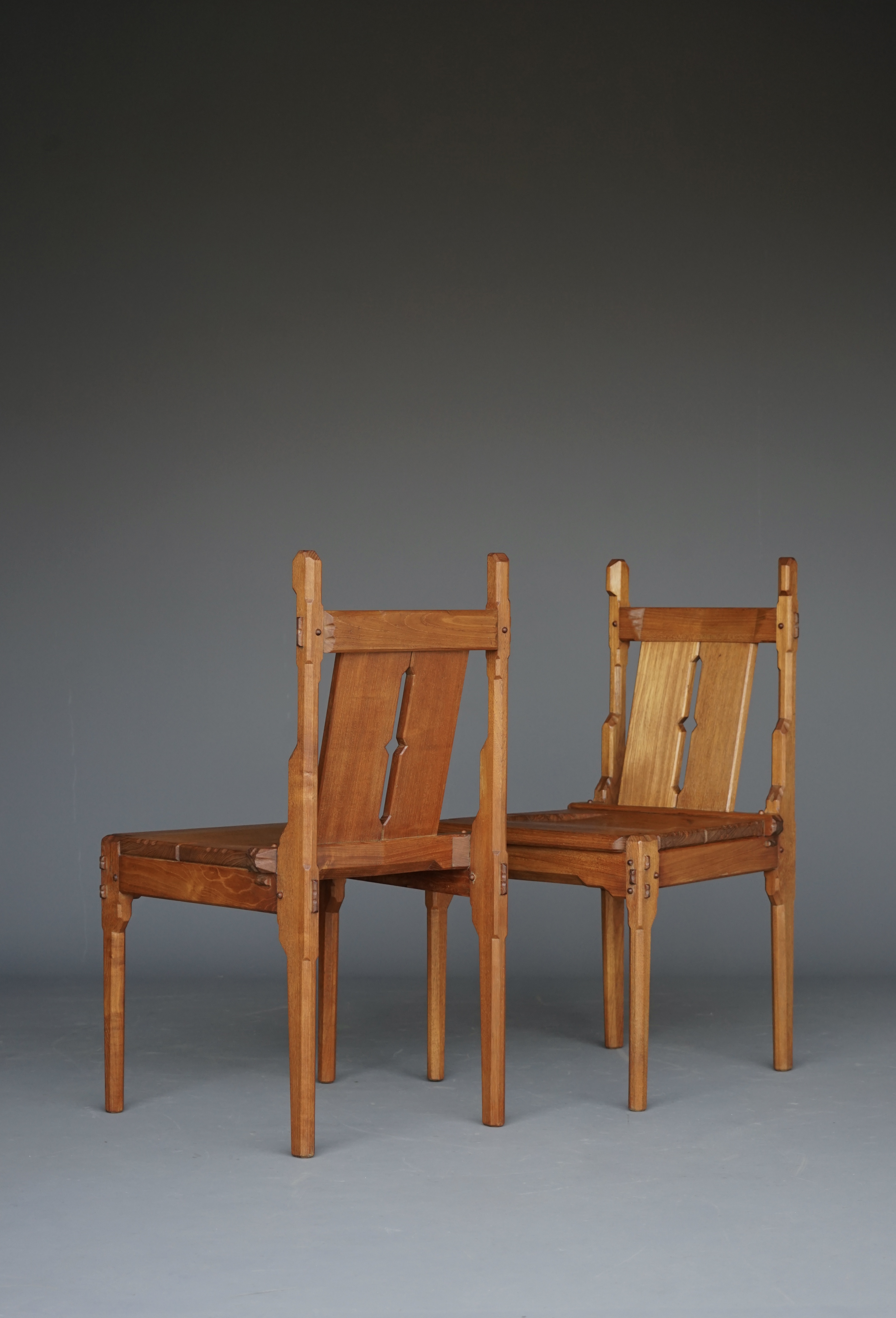
1900-1930s. Oregon pine garden set – Consisting of four chairs (two shown) and a table.

Possibly of Scandinavian origin. A wonderful example of early modernist knock-down / flat-pack furniture.

Table – Sold

x4 chairs – 1,800.00 euro

www.merzbaufurniture.com