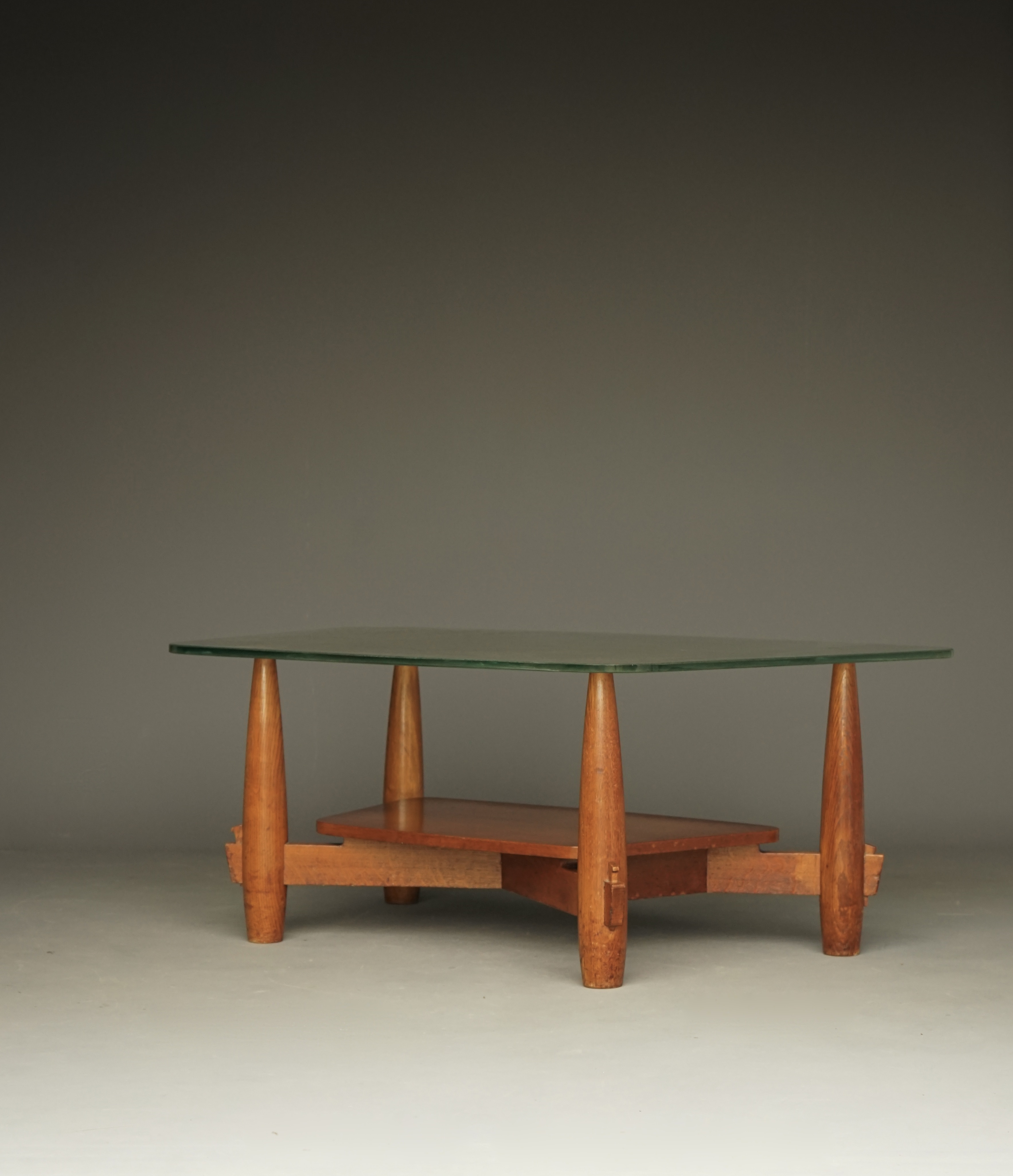
Large Art Deco coffee table. Circa 1930s

131 x 86 x 52cm high. Solid oak and glass.

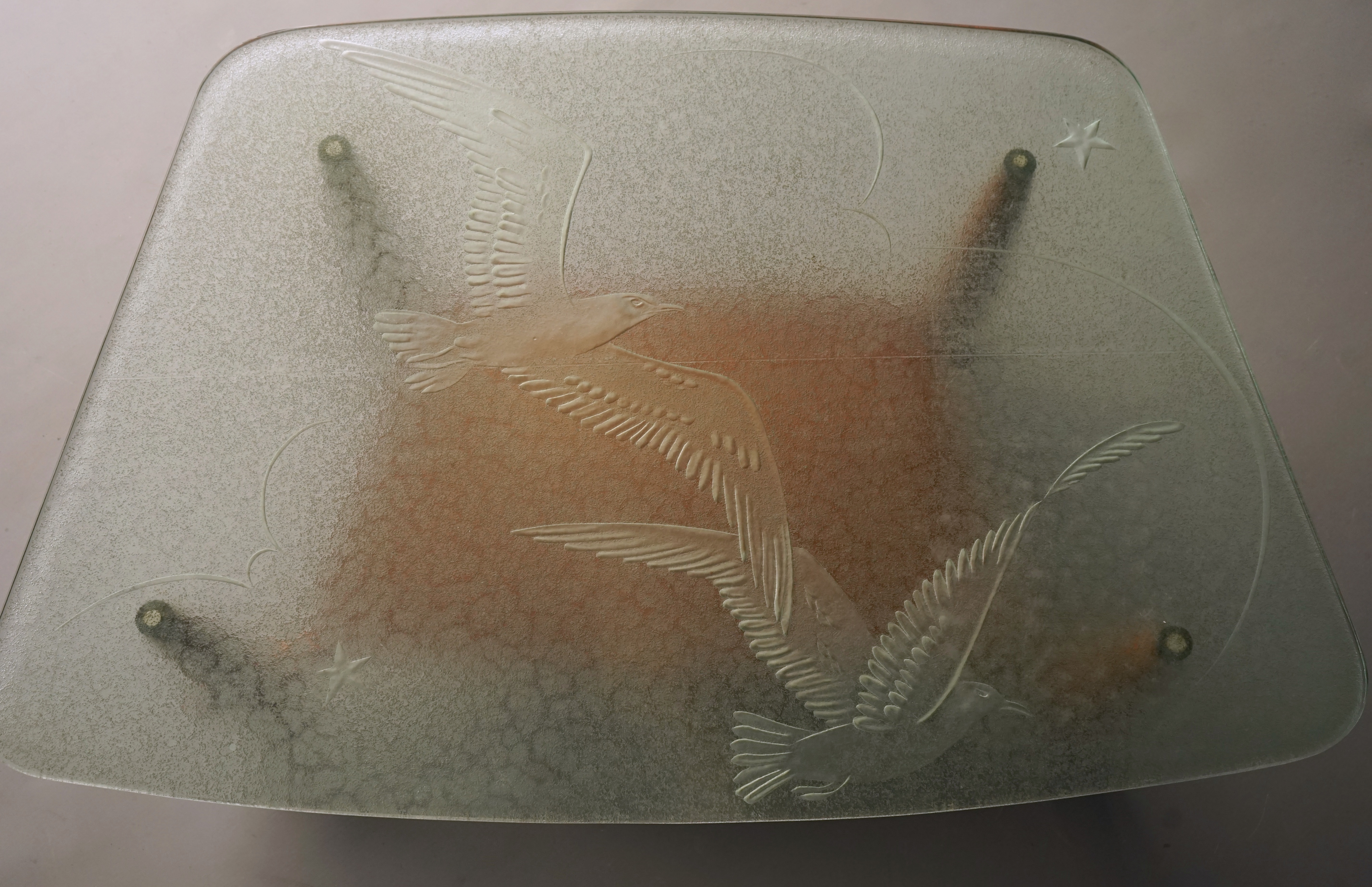
Unique early c20th coffee table with its original feature glass top that seems to conjoin both Art Deco and Brutalist styles. The piece combines the robust qualities of the Brutalist style evident in its chunky wooden base with the elegance of the Art Deco style manifested in the pictorial glass top. These apparent combined qualities in this one piece that gives the table its unique style and character.
The deeply moulded relief images in the thick glass depicts two seagulls in flight. The underside of the glass is textured whereas the top is almost smooth.

The curved fan shape of this table (it is narrower at the front than the back) would make it highly suitable for particular spaces such as between sofas or in front of a curved sofa.

Price: 3.950 euro

http://www.merzbaufurniture.com

Wegner oak table

Hans J. Wegner (Dk 1914-2007)

Oak Model AT 310 Extendable Dining Table by Hans J. Wegner for Andreas Tuck, 1960s

A dining table designed by Hans Wegner in 1955. This classic piece of Danish modernism: simple and understated.

Included are two extension leaves that can be stored at the underside of the table. (each leaf is 40 cm wide so it is 160cm wide without the additional leaves)
The table is fully marked at the underside. Andreas Tuck, Denmark.

240 (extended) x 94 x 72cm high.

Price: 3.950 euro

http://www.merzbaufurniture.com

Delft School bench

200 x 44.5 x 65.5cm high (seat height 43cm)

A stylish Delft School small oak bench / School of M.J. Granpré Molière or A.J. Kropholler .

Traditionalism in the Netherlands emerged shortly after the First World War. It was not so much a style as more of an attitude among architects who, in response to Functionalism and the Expressionism of the Amsterdam School, rediscovered the purity and simplicity of traditional country architecture. Under the leadership of M.J. Granpré Molière, professor at the Technical University in Delft from 1924 until 1953, many of these architects gathered in a movement which after World War Two became known as the Delftse School (‘Delft School’). Granpré Molière’s ideas include a preference for tidy brickwork, a minimal use of decorations, the inspiration taken from national architectural traditions and the use of ‘honest’ (i.e. traditional and natural) materials.
https://www.archimon.nl/history/traditionalism.html

It is easy to comprehend how subsequent Dutch design evolved into an even more simplified and pared-down version of such furniture as this. There are clear visual similarities to Rietveld or De Stijl.

Price: 2.600 euro

http://www.merzbaufurniture.com