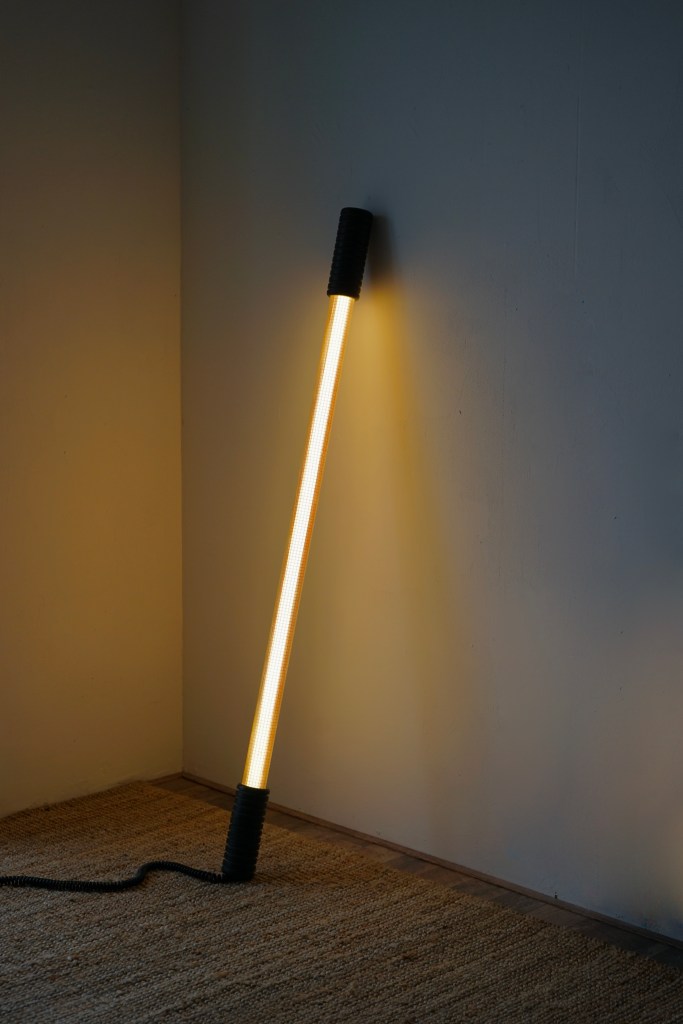
Floor-neon lamp. Designed around 1977, the edition was for Starck Product or Electrorama circa 1980. Stamped ‘Starck Product’.
Makrolon, polyurethane and fluorescent tube H: 142 cm. (56 inches); D: 6,7cm.(2 3/8in.). The lamp has an inbuilt mercury tilt switch (the lamp lights up when its position is slightly altered)
This lamp was most likely purchased in the Netherlands at De Bijenkorf, circa 1980. Bibliography: J.-F. Grunfeld, M.-L. Jousset, Lumières Je Pense à Vous, exhibition catalog, Centre Georges Pompidou, Paris, June 3-August 5, 1985, p. 158, n. 282 C. Colin, Starck, Ed Pierre Mardaga, Liège, 1988, p. 274, 278, 296
The model 020 ‘Stick’ chair was designed by Dutch industrial designer Bruno Ninaber van Eyben in 1977.
The design is made up of three constituent parts that fit together: two pieces of angled plywood and a length of stick with a round profile. The stick in the middle connects the plywood pieces and functions as the backbone and strength of the chair.
These rare chairs were manufactured in very limited numbers due to the production costs and difficulties. Only 150 of these chairs were produced. Apart from its low production numbers the other reason that so few exist is because they can easily get damaged – Due to the stool’s fragility we recommend that it should be purchased by a design lover that appreciates its sculptural qualities rather than its functionality!
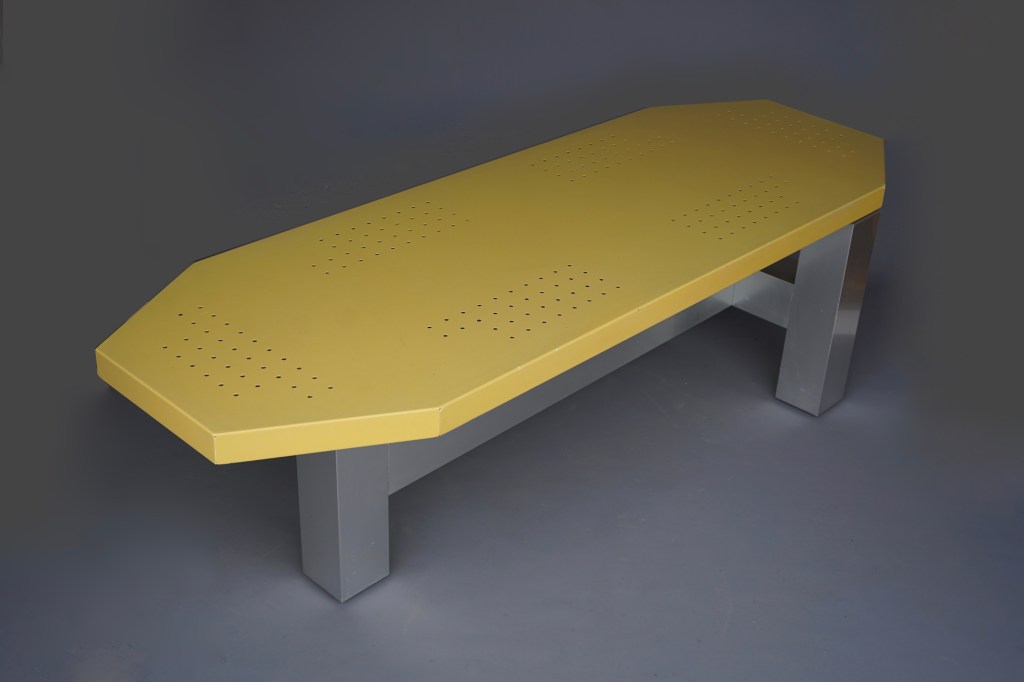
’t Spectrum Bergeyk 1988. Model TE20. Aluminium and lacquered steel.
Rare modernist table designed by Martin Visser and Joke van der Heyden. This particular table appears to come from a small test series (or one of a series of prototypes whereby Visser was still experimenting with the design – there are some quite primitive connections and test holes where you can see Visser grappling with the design).
These first tables have a slightly different build than the later production tables; they do not have the rubber connections between the top and leg structures that the later tables had – Instead the illusion of the top floating above the base is created by incorporating a slight gap between the top and base sections. The same illusion is created at the base of the legs where a single rubber beyond view creates the illusion of the whole table floating slightly above the floor.
The booklet entitled ‘Martin Visser, collected work‘ contains a full description of the creation of the TE20.