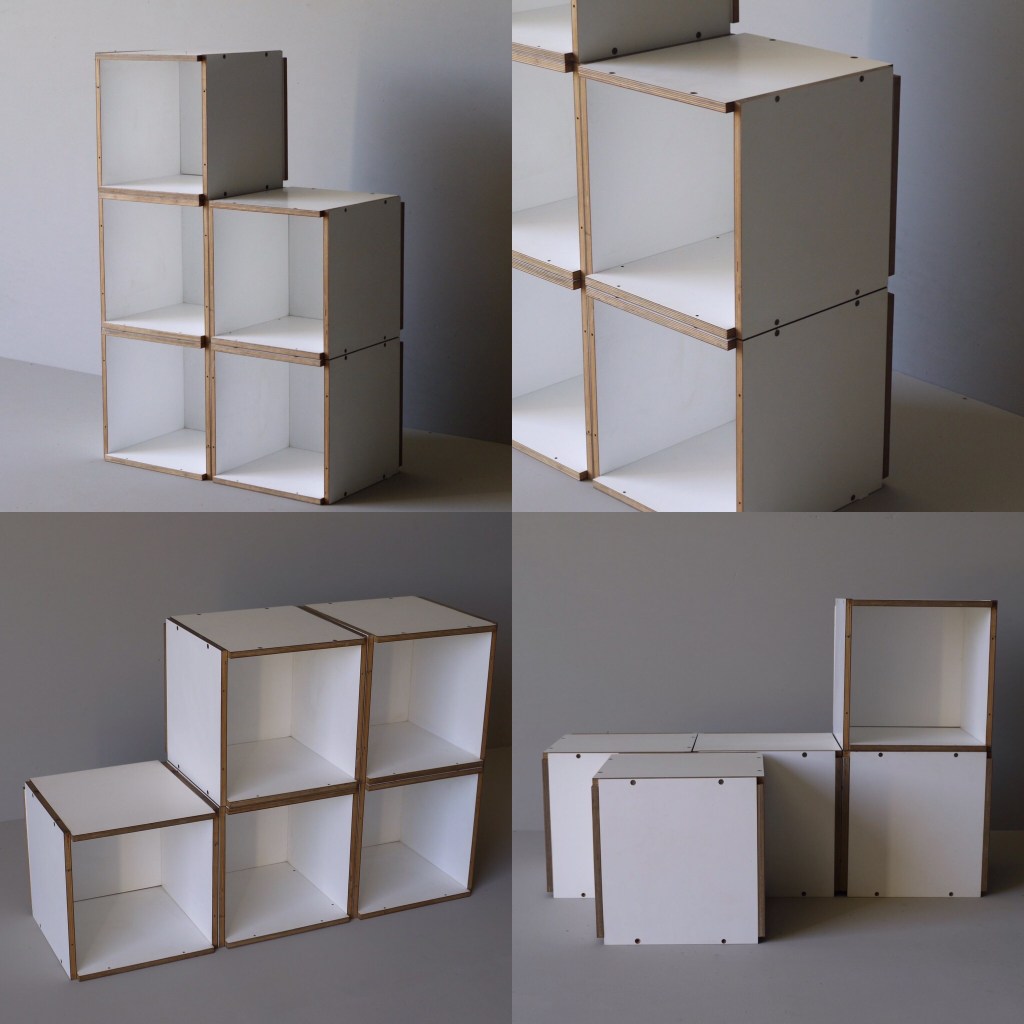
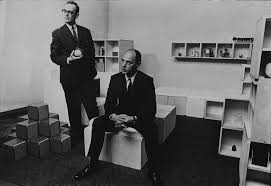
Jan Slothouber & William Graatsma (NL. Mid-c20th) Five original modular cubes from the 1970s. Laminated plywood. . The Dutch duo Slothouber & Graatsma established themselves from the 1950s as artist/designers with the cube form as their key motif around which they developed various principles of cubic construction alongside multiples and variations thereof. Despite its restrictions they admired the cube for its clarity of form. They applied their thinking around it to a variety of objects, and artworks from small jewellery-scale 3d models and games to larger installation works. Highly driven personalities, they considered themselves as discoverers of ‘the many applications of the democratic system of cubics’; a system that would ostensively act to counter the rise of the expressive individualism in post-WWII culture. (They later established the CCC_the Center for Cubic Constructions as a forum for promoting their ideas). Due to their diverse and multidisciplinary output they were never to become global names – But they were a highly respected creative team (representing The Netherlands at the Venice Biennale in 1970) and in 1965 the Stedelijk Museum in Amsterdam honoured them with the exhibition ‘Vier kanten: maat, vorm, kleur, letter’ (Four sides: size, form, colour, letter). Donald Judd for one was a great admirer of their work.
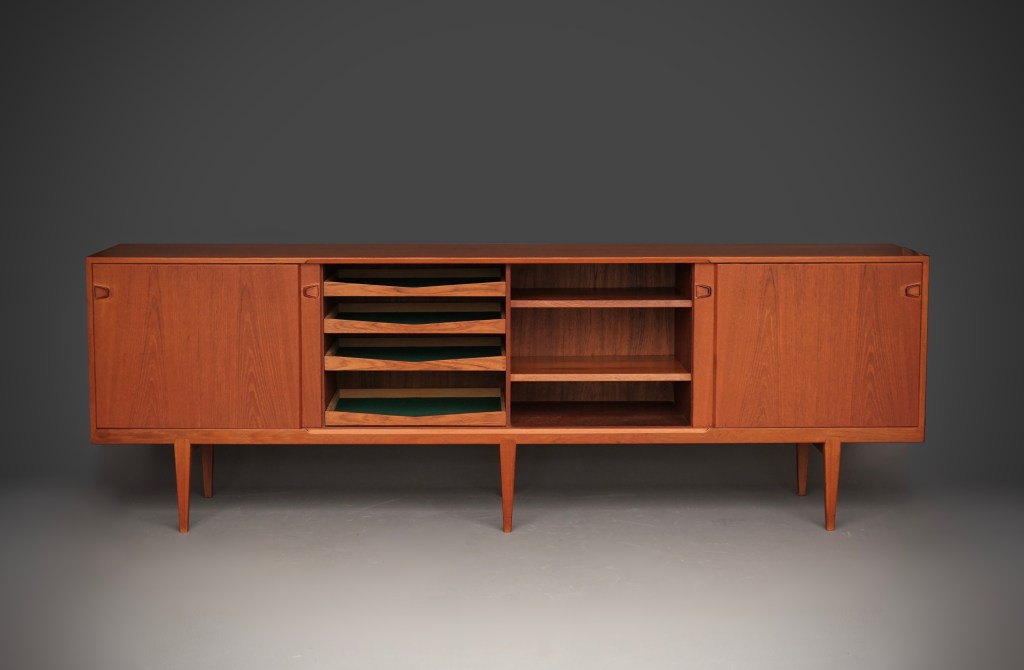
A very rare long teak sideboard with sliding doors designed by one of the best of Danish designers for one of the top Danish companies. The beauty with these sideboards is both the simplicity and modesty of design combined with the highest quality of finish visible especially in the details. It has easy sliding doors and a variety of shelves and drawers inside that can be easily adjusted to the required height.
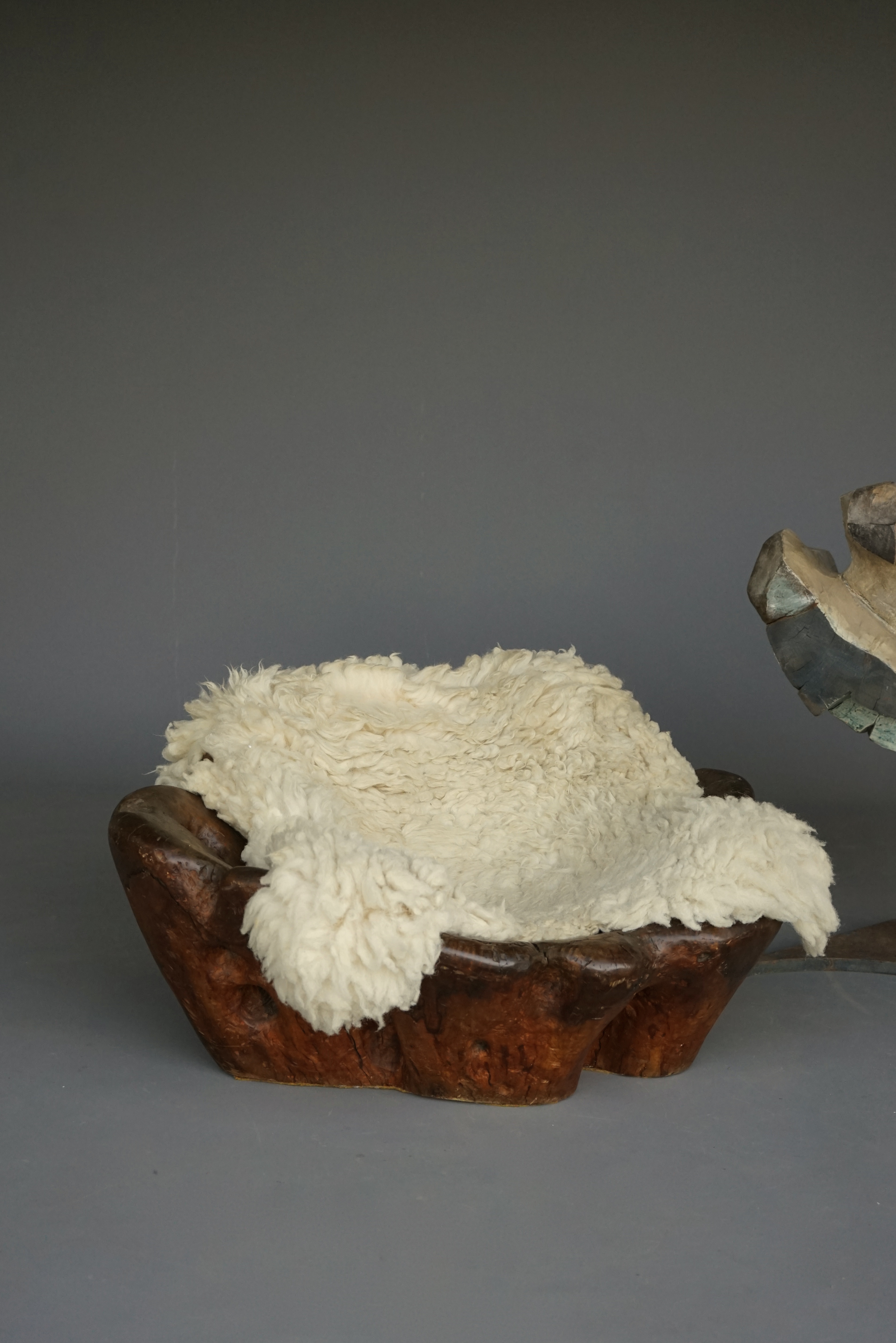
Brutalist / Structuralist chair. Netherlands. Circa 1960s/70s.
Steel & leather/hide.
An interesting architectural chair. Its construction and manufacture lead us to believe that it is possibly a prototype? – Its design reflects the style of post-war structuralist architecture/interiors typical of several Rotterdam architects from the period. (we are still researching the design).
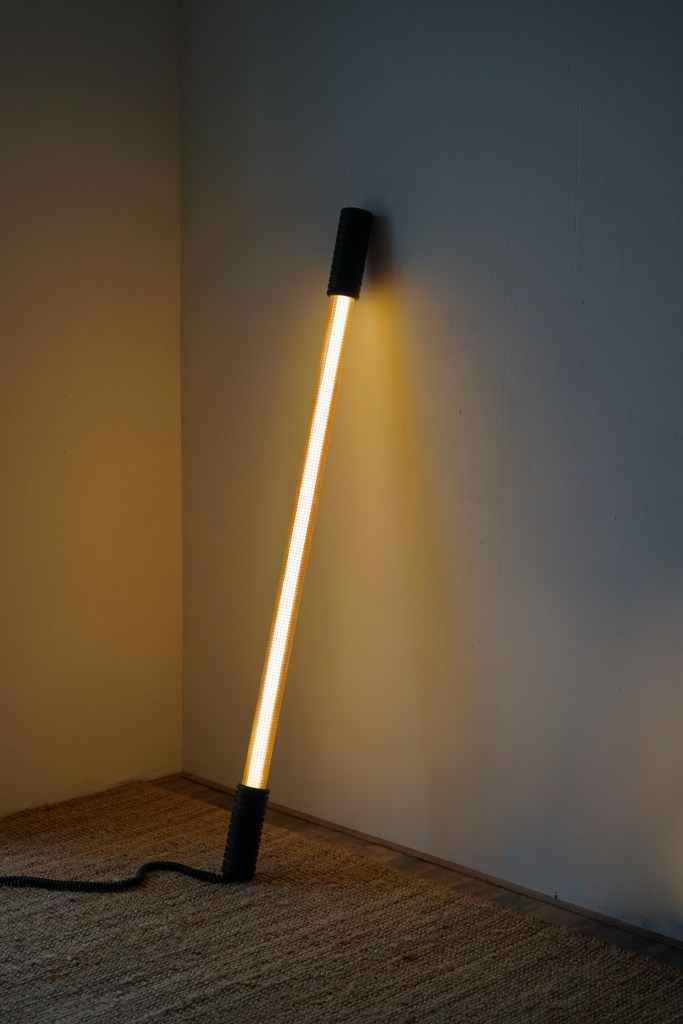
Floor-neon lamp. Designed around 1977, the edition was for Starck Product or Electrorama circa 1980. Stamped ‘Starck Product’.
Makrolon, polyurethane and fluorescent tube H: 142 cm. (56 inches); D: 6,7cm.(2 3/8in.). The lamp has an inbuilt mercury tilt switch (the lamp lights up when its position is slightly altered)
This lamp was most likely purchased in the Netherlands at De Bijenkorf, circa 1980. Bibliography: J.-F. Grunfeld, M.-L. Jousset, Lumières Je Pense à Vous, exhibition catalog, Centre Georges Pompidou, Paris, June 3-August 5, 1985, p. 158, n. 282 C. Colin, Starck, Ed Pierre Mardaga, Liège, 1988, p. 274, 278, 296
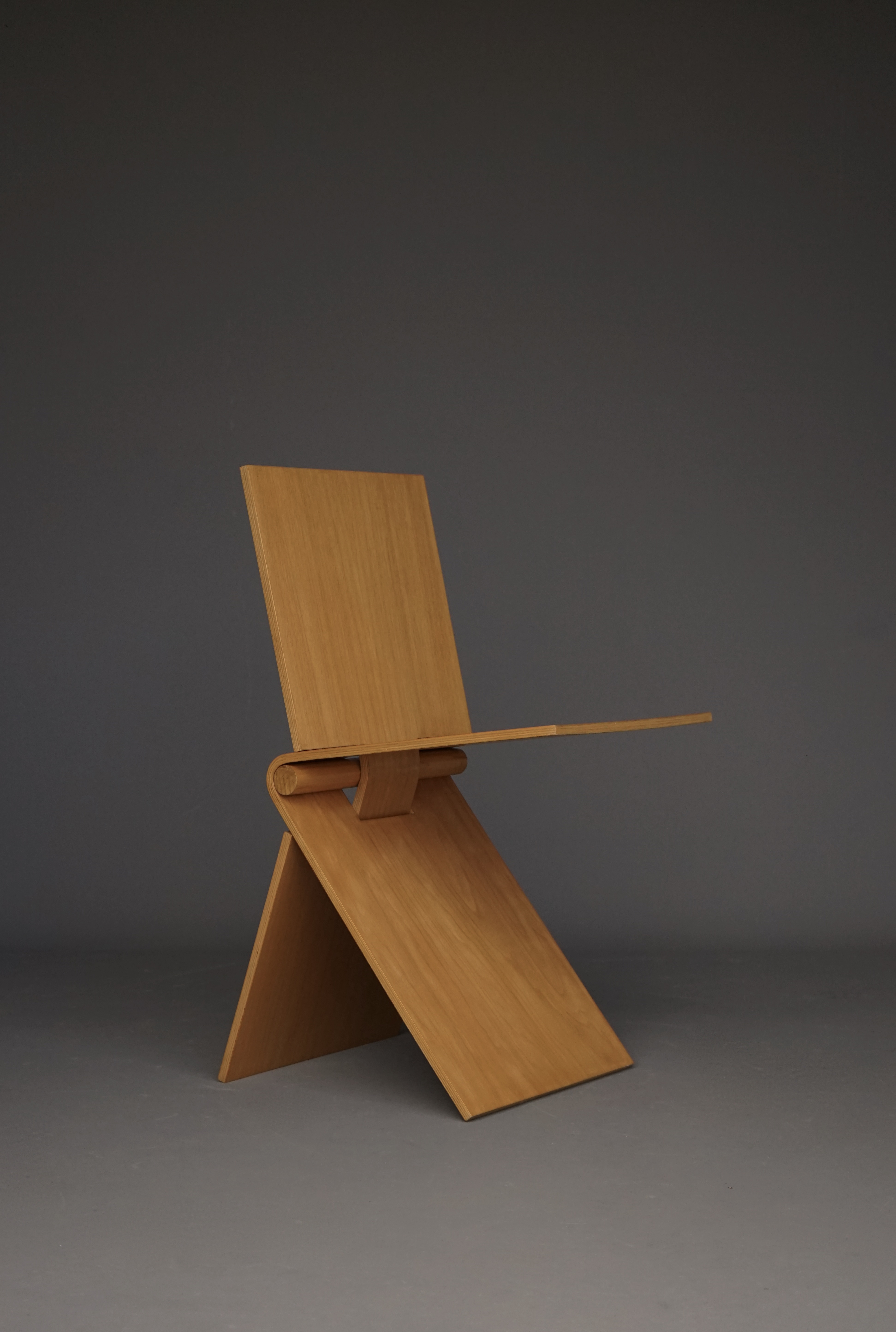
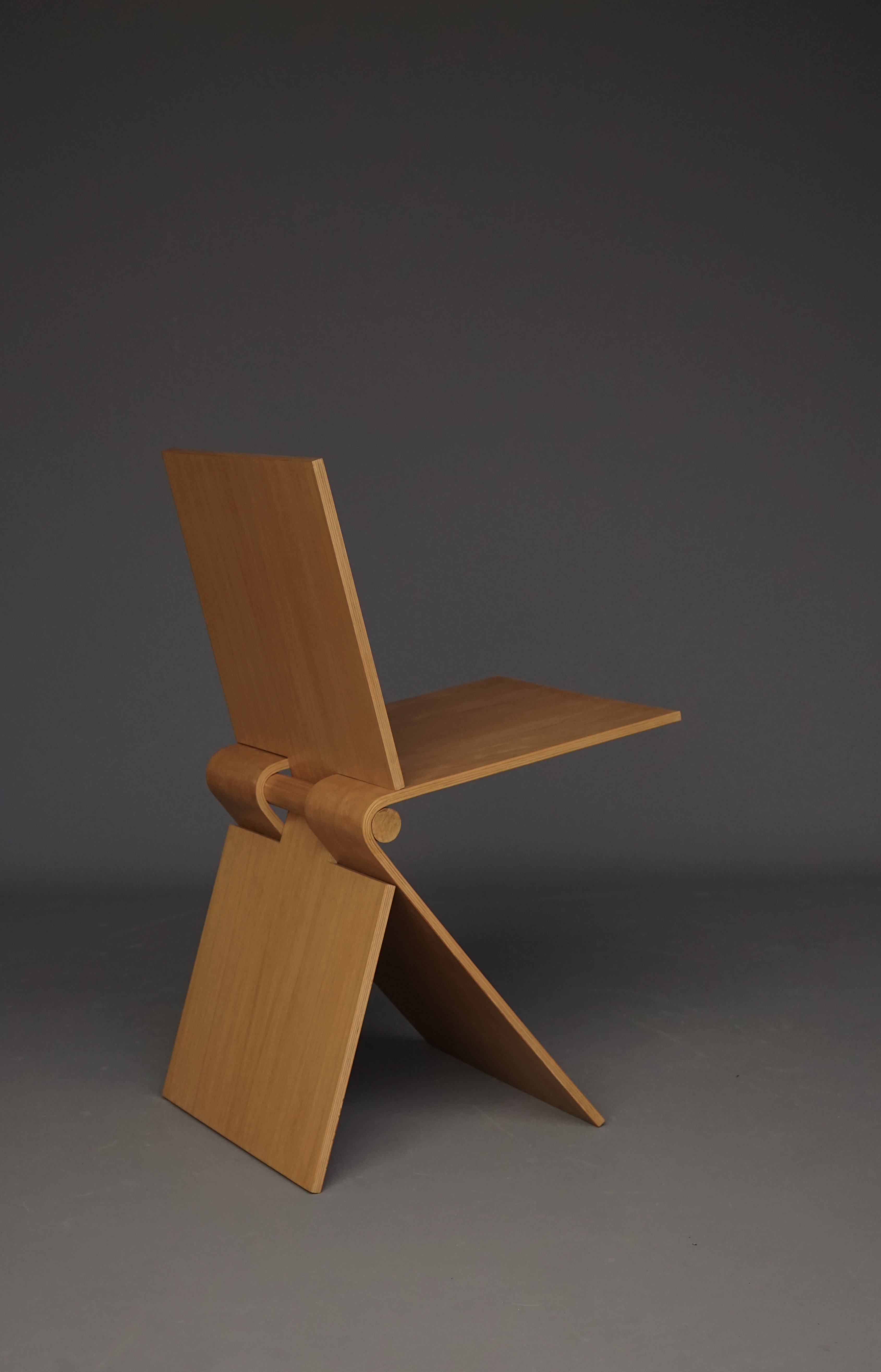
The model 020 ‘Stick’ chair was designed by Dutch industrial designer Bruno Ninaber van Eyben in 1977.
The design is made up of three constituent parts that fit together: two pieces of angled plywood and a length of stick with a round profile. The stick in the middle connects the plywood pieces and functions as the backbone and strength of the chair.
These rare chairs were manufactured in very limited numbers due to the production costs and difficulties. Only 150 of these chairs were produced. Apart from its low production numbers the other reason that so few exist is because they can easily get damaged – Due to the stool’s fragility we recommend that it should be purchased by a design lover that appreciates its sculptural qualities rather than its functionality!