Bernhard Hoetger (Ger. 1874-1949)

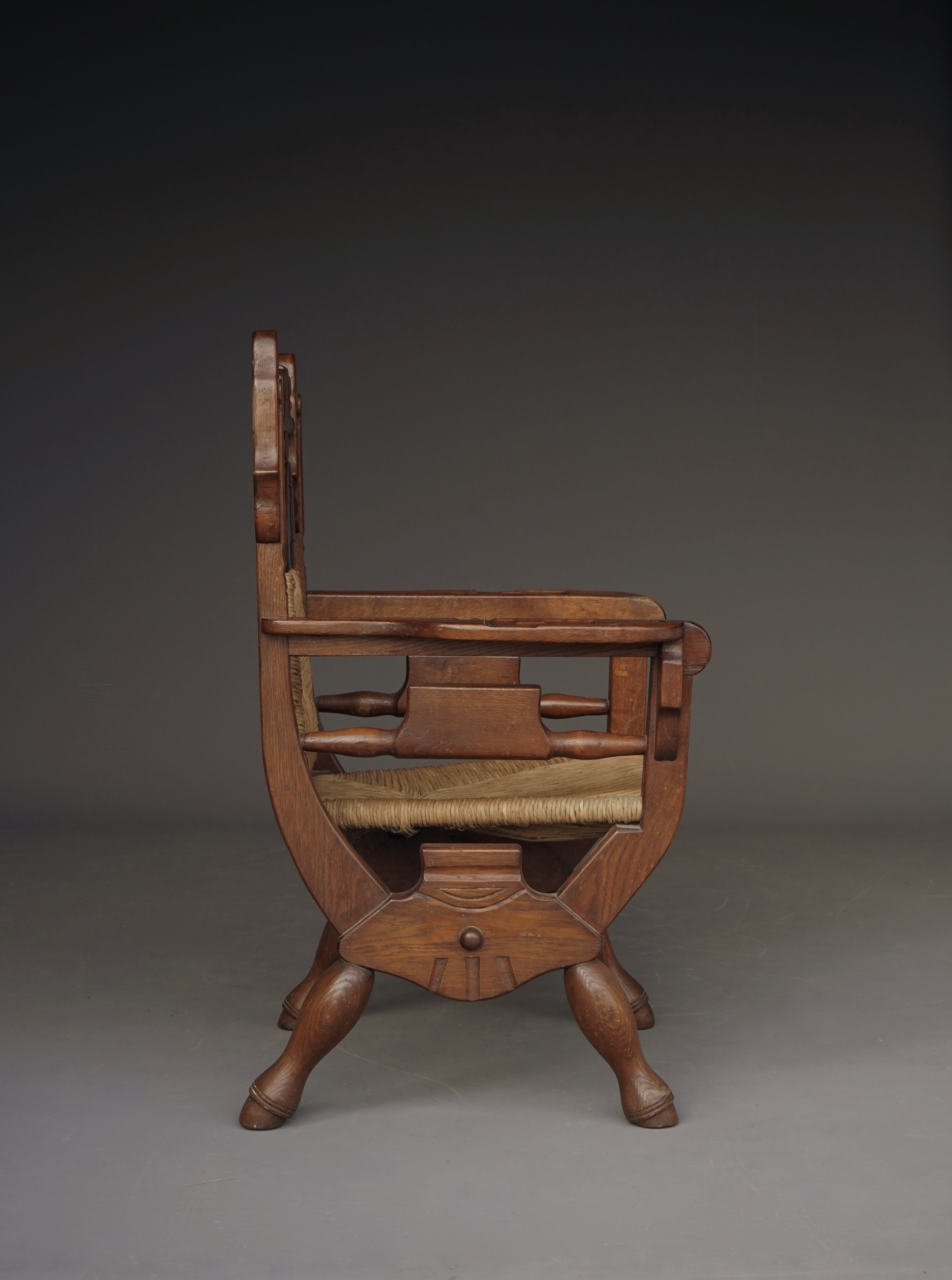
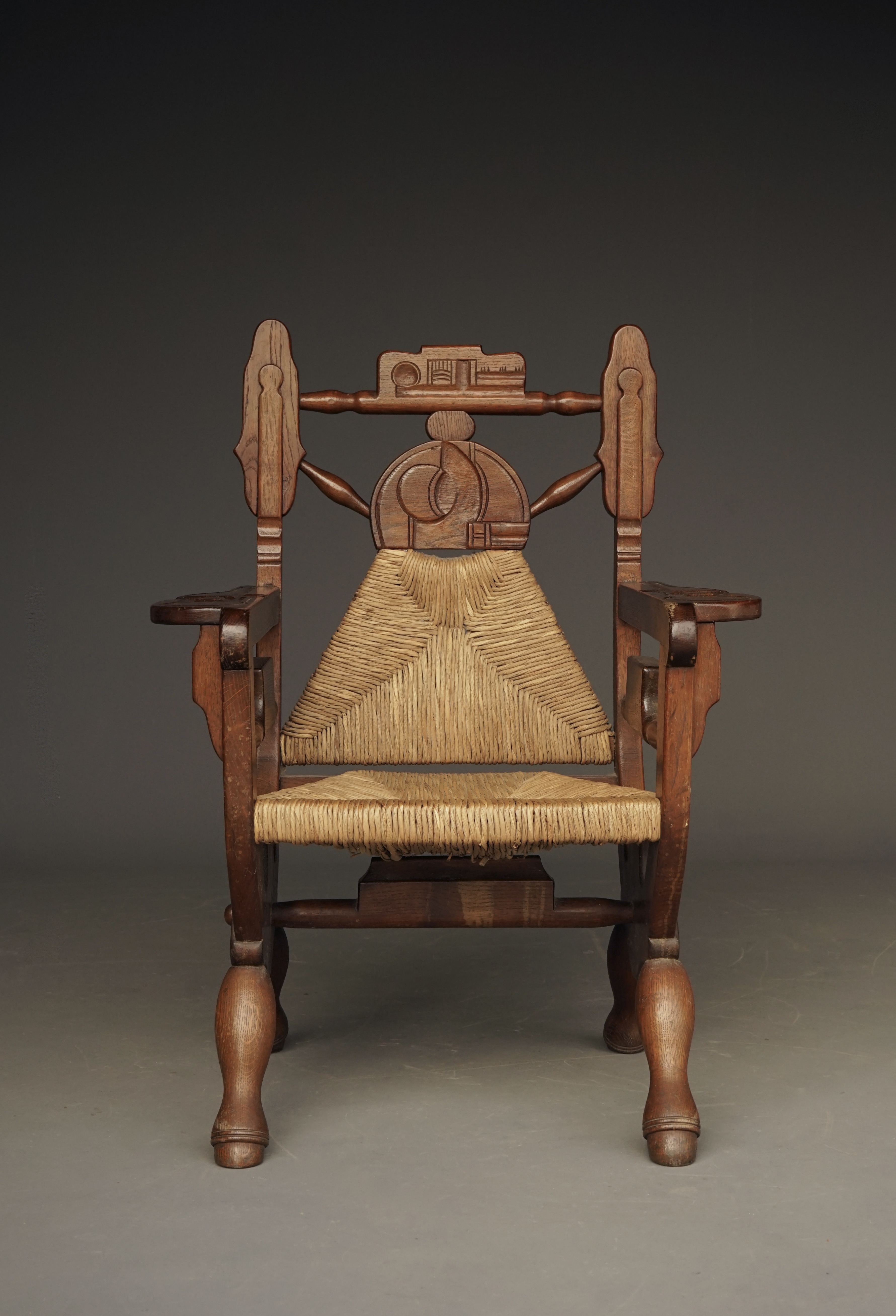
Oak armchair. Manufactured at Worpsweder Kunsthütten, Germany between 1923-27.

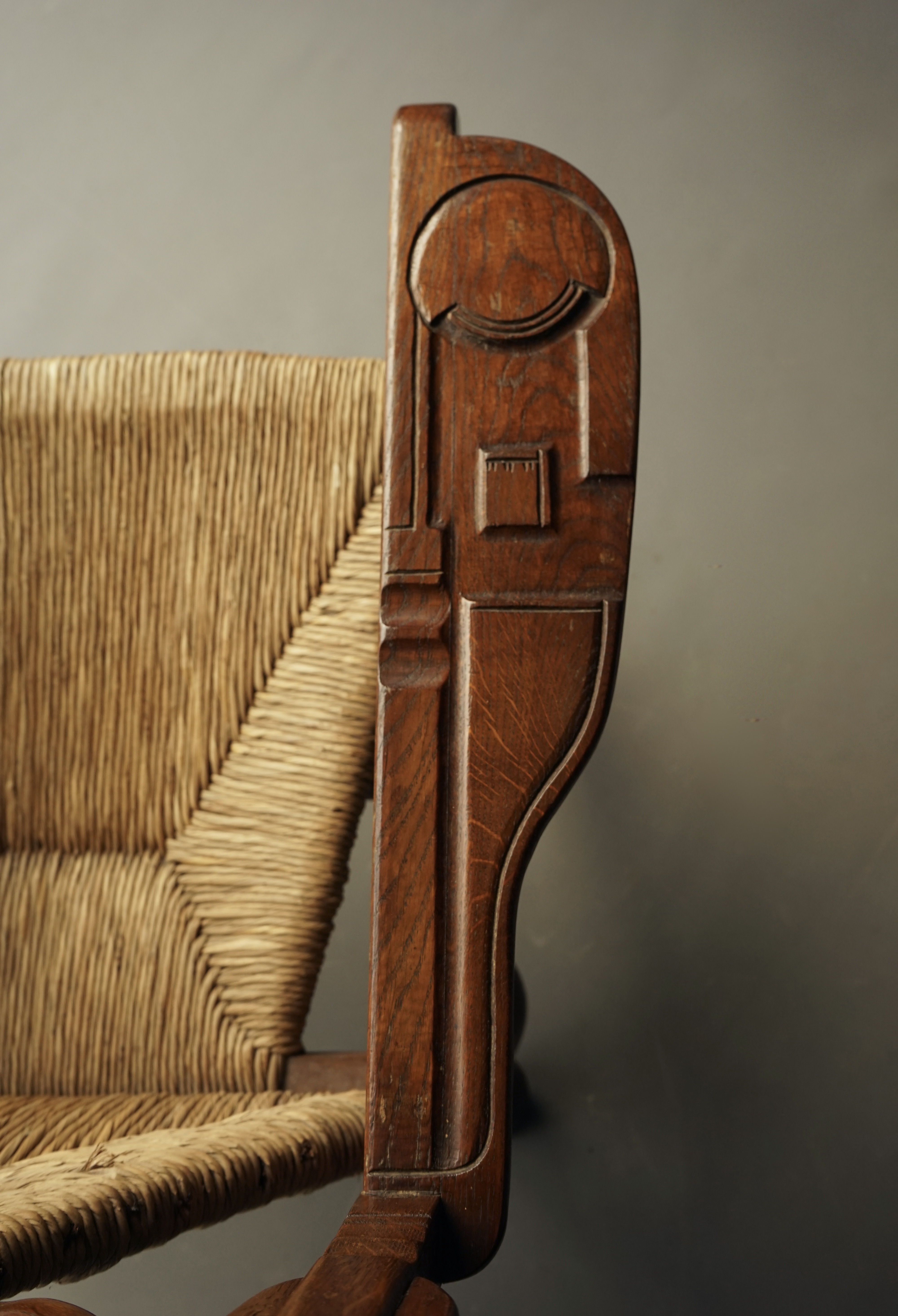
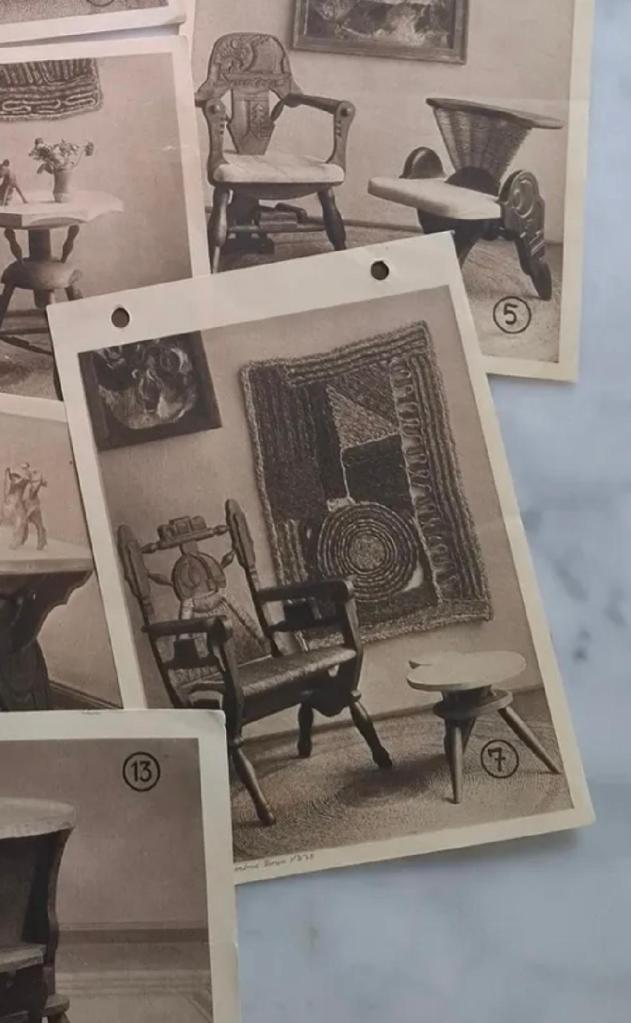
A unique, bizarre and complex designed expressionist oak armchair from 1920s with original rush seat and back.

The chair was designed by sculptor and architect Bernhard Hoetger whose work intersected with völkisch mysticism, esotericism and pseudo-historical mythologies. The spritualist/theosophical movements in Europe started by Madam Blavatsky and colonel Olcott in the 1870s and came to prominence in the 1930s with Kandinsky ‘concerning the spiritual in art’ and soon afer the Bauhaus and anthroposophical movements. Hoetger’s art was part of this wider vision of a new future for mankind in the years following WWI.

Overall, the chair’s form is the manifestation of mystical beliefs: the coinciding of folk art and futurist ideals and racial-pagan utopias.

The chair is created using traditional craft vernaculars and is adorned with a range of carved symbols; various cultural references from Egyptian, Mesopotamian, the Americas, to the Arts & Crafts and Bauhaus movements. Its feet take on the form of goat hoofs that firmly plant it onto the earth and yet the back and arm rests look to the heavens using pictorial abstract designs based planetary alignments and geometry.

Worpsweder Kunsthütten were a group of experimental arts & crafts workshops founded in 1923 by Bernhard Hoetger in the Worpswede artist’s colony. Operating until 1927, the workshops brought together young artisans to create avant-garde, expressionist objects from clay, metal, and wood.

Ref: a version of this chair is pictured in the catalogue of the Worpsweder Kunsthütten from 1924 (shown in stories)Ref: a version of this chair is pictured in the catalogue of the Worpsweder Kunsthütten from 1924 (image below)
Price: On request

http://www.merzbaufurniture.com

Ko Verzuu (Netherlands 1901-1971)

A rare toy chair designed by Ko Verzuu for ADO. Circa 1930s.

plywood 19 x 20 x 20.5cm high (with original cushion). Early brandished mark to the underside (with an early understandable misattribution to Rietveld)

Between 1925 and 1955 Dutch designer Ko Verzuu designed many toys under the influence of the Dutch Modernist De Stijl painters. His designs were inextricably bound up with innovations in art, health care and pedagogy in the first half of the 20th century. In 1920, the sanatorium Berg en Bosch was founded in the sanctuary on the outskirts of Apeldoorn. This sanatorium offered rest and care to tuberculosis patients. Once patients had recovered from their illness, returning to regular working life often proved to be difficult. In order to prepare patients better for their reintegration, the sanatorium developed a modern treatment: occupational therapy. One of the ways this took shape was in the production of wooden toys. These toys were given the name ADO; an abbreviation that initially stood for Arbeid door Onvolwaardigen (Labour by the Deficient), but was wisely changed in 1962 to Apart Doelmatig Onverwoestbaar (roughly translated as Special Functional Indestructible).

Price: 1.000 euro

http://www.merzbaufurniture.com

model 3 desk lamp

Sybold van Ravesteyn (Nl 1889-1983)

Model 3 desk lamp. Metal & lacquered wood.

_Originally designed in the 1926, a few limited productions of the design were manufactured in the 1970s. This particular lamp is a very rare 1970s production that was the most faithful to the original series of only 8 lamps that were made. This version has wooden black and white sections (like the original). It has a screwed in metal plate around the two switches (like the original) and a cleaner top edge (without a plastic protector shield that some versions have)

(please note that this is not a DS 23 Huszár lamp)
.
12 x 10.5 x 26.5cm /without bulb

Lit: Sybold van Ravesteyn architect; Kees Rouw, Nai010 uitgevers/publishers, 2014 pp.59

Price: 2.800 euro

http://www.merzbaufurniture.com

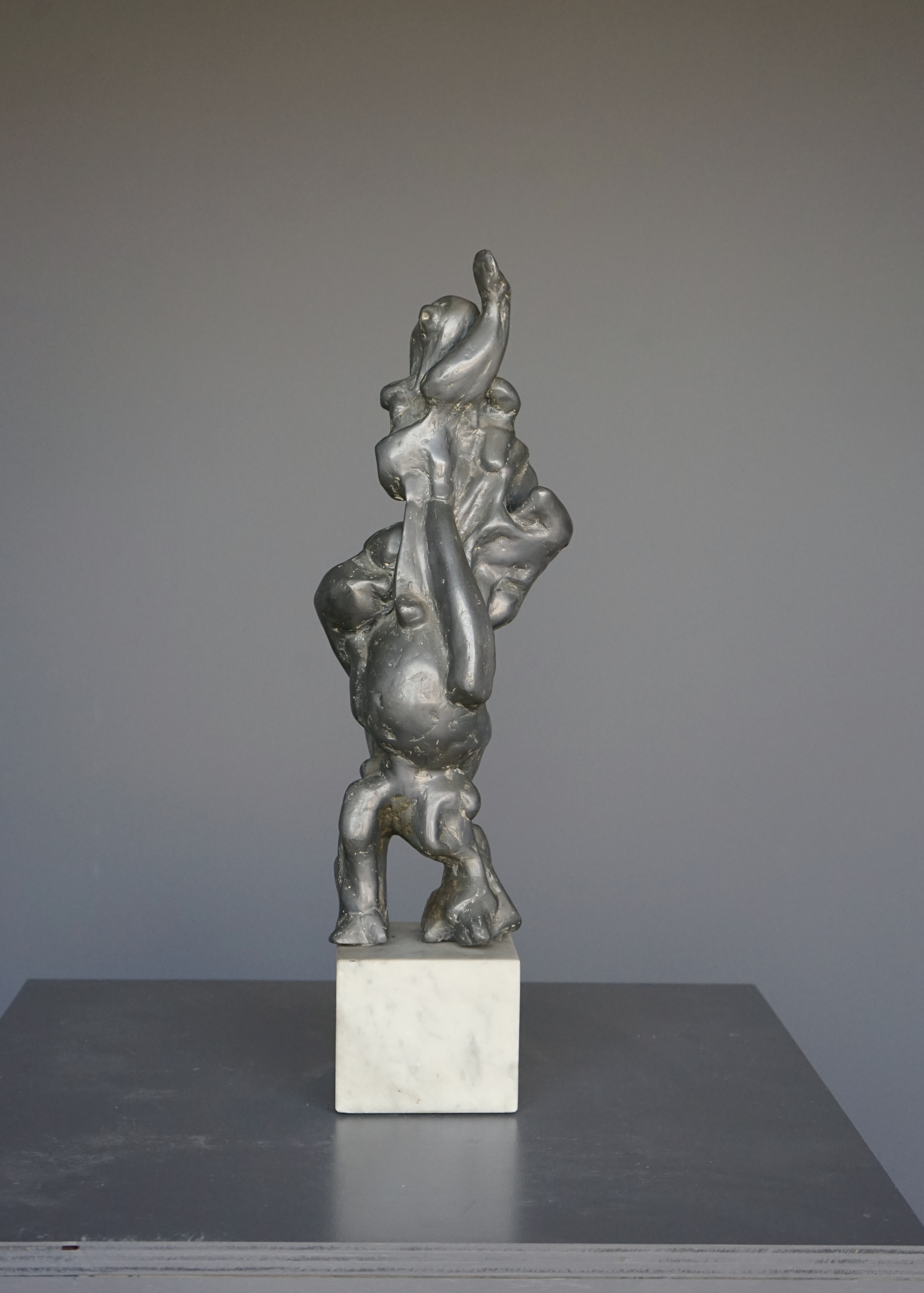
Midcentury abstract sculpture

Unsigned 1960s sculpture.

Lead and marble. 57cm high / base 12 x 12cm.

A large and heavy abstract lead sculpture executed by an unknown artist in the 1960s. Its overall impression is of a modern dynamic figure in molten lead; a figure morphing into various biomorphic or abstract forms.

Price: 875 euro

http://www.merzbaufurniture.com

Abstract sculpture

1970s Brutalist abstract sculpture. Unsigned.

A large basalt stone sculpture composed of simple modernist/architectural forms. At some time this sculpture has stood in a garden which has resulted in a thin layer of moss on some parts.

It measures 36 x 12 x 45cm high.

Price: 1.500 euro

http://www.merzbaufurniture.com

Anton Cepka (Czech.1936-now)

BROOCH WITH SMOKY QUARTZ GEMSTONE. 1970-1974. Brooch made of silver plate with finely engraved net decoration, set with cabochon-shaped smoky quartz gemstone. Artist’s original by most famous Slovak jeweler Anton Cepka. Ag 900/1000. Total weight 140 g, length 11,6 cm, height 4,7 cm.

Compare with: H. W. Drutt English, P. Dormer, Jewelry of our time. Art, ornament and obsession, London 1995, p. 96. – Á. Schrammová: Anton Cepka – šperky a objekty, in: 53. Bulletin of Moravia Gallery in Brno, Brno 1997, p. 208-210.

1,100.00 euro

http://www.merzbaufurniture.com