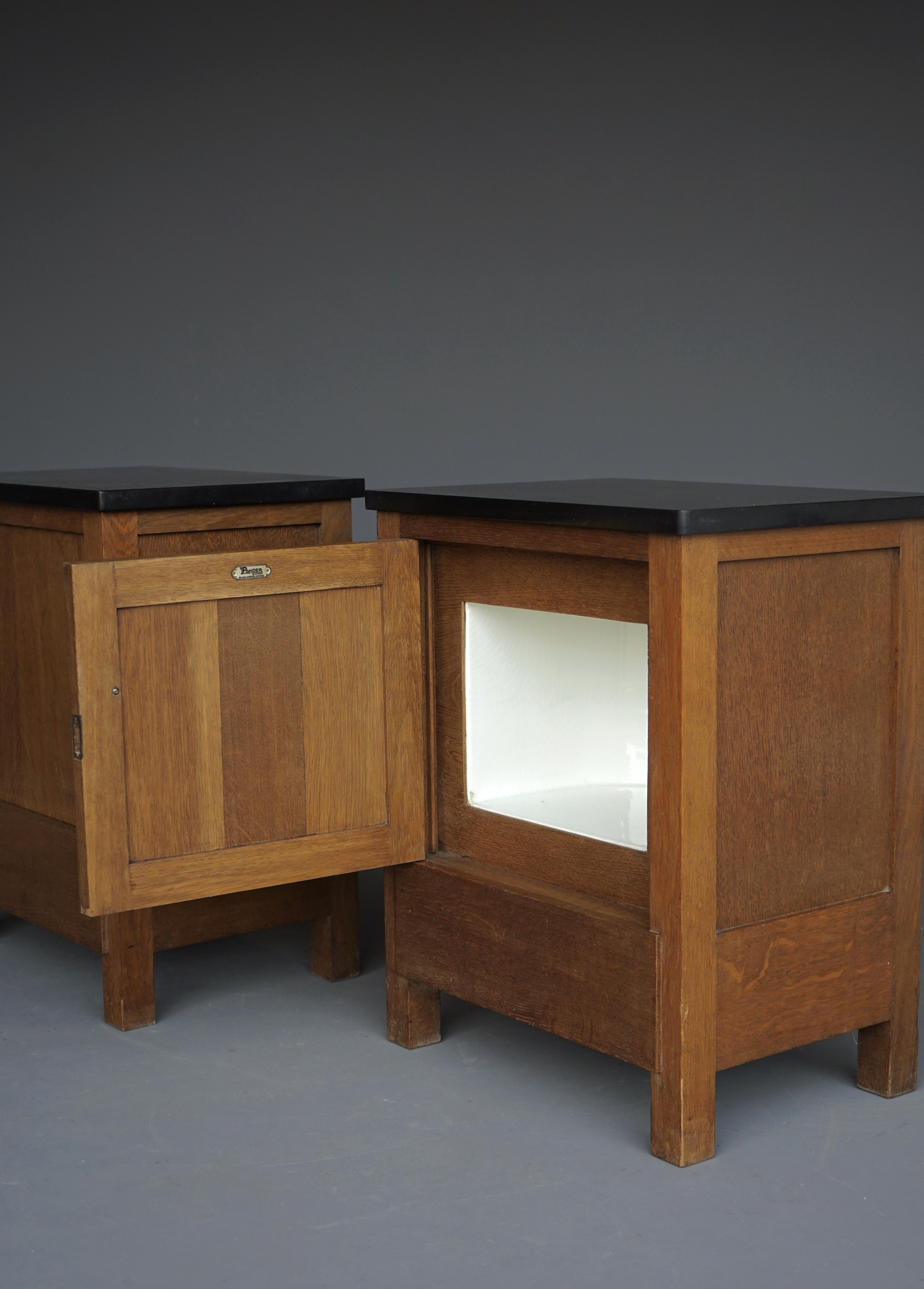
Piet Klaarhamer (Nl 1874-1954)

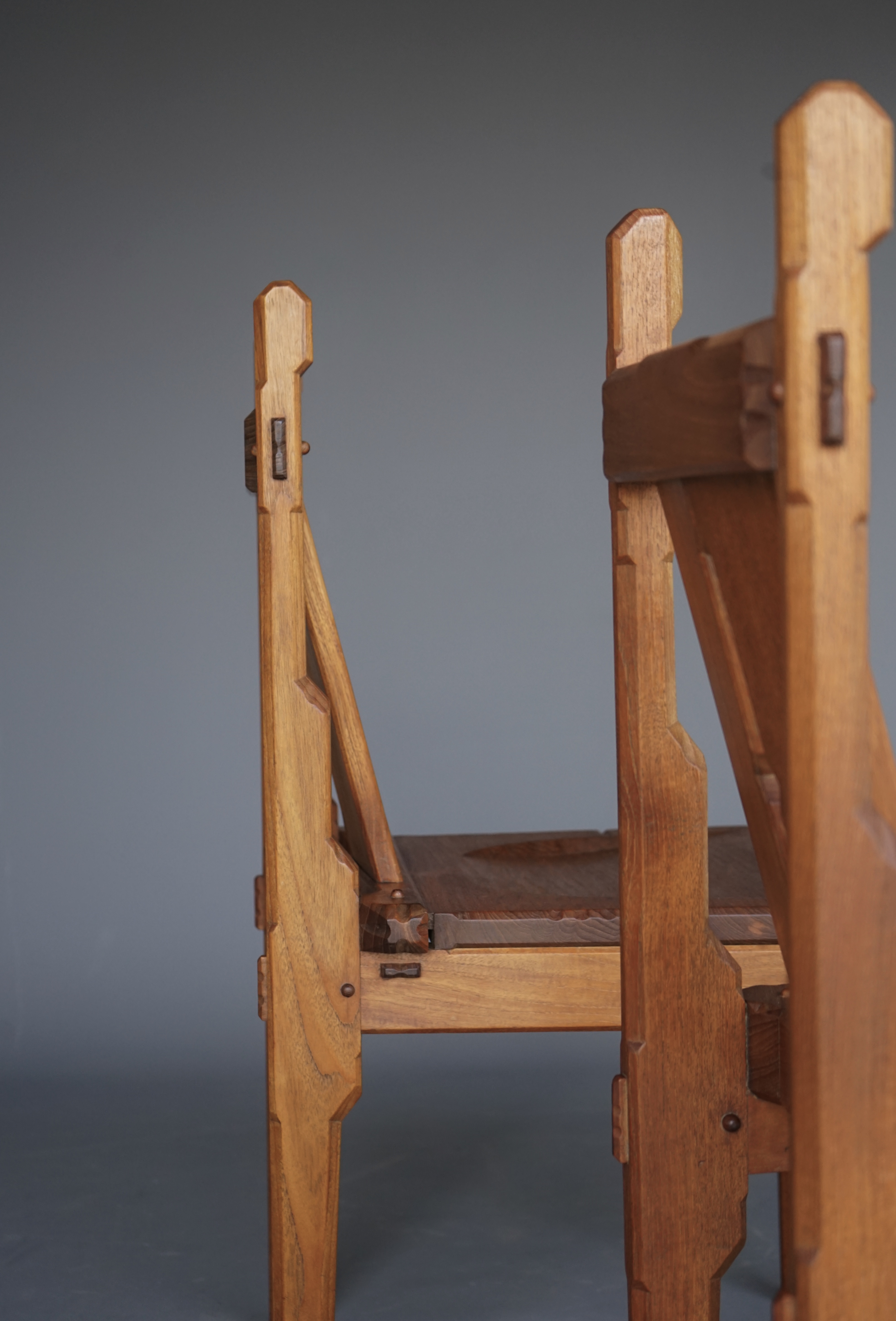
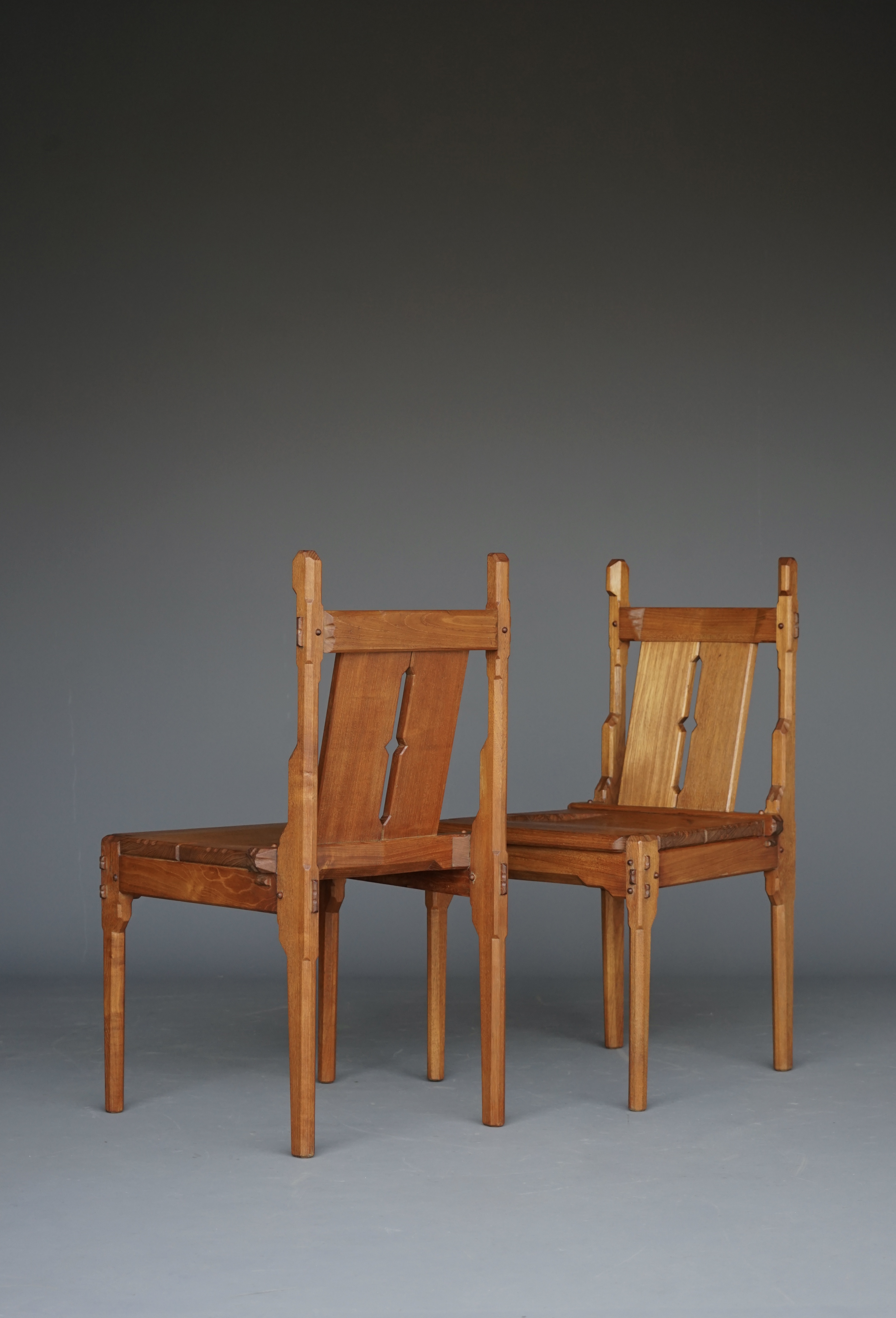
Pair of oak chairs with green leatherette upholstery. Circa 1917.

The early designs of modernist architect Piet Klaarhamer use simple, rudimentary constructions, and demonstrate an honest use of the materials used.

We have two of these chairs for sale – These important chairs were the first pieces of furniture that Klaarhamer designed that were produced in larger quantities around 1917, (although probably still manufactured in very limited numbers) by company called NV Nederlandse Meubel en Houtwarenfabriek in Zaandam.

Klaarhamer’s designs had a clear influence on his students, including the well-known architects Piet Elling and Gerrit Rietveld.
The design of this particular model (without arms) inspired Rietveld in the design of his well known ‘Military Chair’ in 1923. It is a design that is well documented in the monograph on Klaarhamer written by author/historians Marijke Kuper & Monique Teunissen*. This book details a letter (with a sketch of the chair) by Gerrit Rietveld to the architect J.J.P Oud.

Price: On Request

http://www.merzbaufurniture.com

*Literature: Piet Klaarhamer Architect en Meubelontwerper. Marijke Kuper & Monique Teunissen, nai010. 2014

Ko Verzuu (Netherlands 1901-1971)

A rare toy chair designed by Ko Verzuu for ADO. Circa 1930s.

plywood 19 x 20 x 20.5cm high (with original cushion). Early brandished mark to the underside (with an early understandable misattribution to Rietveld)

Between 1925 and 1955 Dutch designer Ko Verzuu designed many toys under the influence of the Dutch Modernist De Stijl painters. His designs were inextricably bound up with innovations in art, health care and pedagogy in the first half of the 20th century. In 1920, the sanatorium Berg en Bosch was founded in the sanctuary on the outskirts of Apeldoorn. This sanatorium offered rest and care to tuberculosis patients. Once patients had recovered from their illness, returning to regular working life often proved to be difficult. In order to prepare patients better for their reintegration, the sanatorium developed a modern treatment: occupational therapy. One of the ways this took shape was in the production of wooden toys. These toys were given the name ADO; an abbreviation that initially stood for Arbeid door Onvolwaardigen (Labour by the Deficient), but was wisely changed to Apart Doelmatig Onverwoestbaar (Special Functional Indestructible) in 1962.

Price: 1.300 euro

http://www.merzbaufurniture.com

Locus Solus chairs

Gae Aulenti (Italy 1927-2012)

Set of 4 ‘Locus Solus’ chairs for Poltronova, Italy 1960s

55.5 x 54 x 66.5cm high

enamelled black tubular metal frames with perforated seats. This set comes with their original loose waxed cotton cushions with dotted black on grey pattern. The design of these chairs was intended to be a playful take on the classic bentwood design.

Price: 4.400 euro (the set)

http://www.merzbaufurniture.com

Leonard Wyburd (Uk 1865-1958)

Liberty & Co ‘Thebes stool‘. Designed by Leonard Wyburd. Mahogany 44 x 40 x 34cm high.

(Evidence of a previous Liberty & Co label to underside).


Manufactured circa 1880s whilst Wyburd was head of the furniture and decoration studio at Liberty’s of London.
As the stool’s name implies, the design of this tripod stool was modelled on ancient Egyptian typologies. The design was the basis of similar stools presented later by both Josef Frank and Adolf Loos (as seen at the Möbelmuseum Wien).

Price: 2.200 euro

http://www.merzbaufurniture.com

Enzo Mari (Italy 1932-2020)

Autoprogettazione Chair ‘Sedia 1’, after a design by Enzo Mari, 1990s.

Pine wood and nails. 50 x 52.5 x 85cm high (seat 47cm high)

In 1974, the Italian designer Enzo Mari published 19 furniture designs that one could make by oneself in his book ‘Autoprogettazione?’. With this programm he created a counter proposal to the paradigm of mass consumption, an alternative to formalism and opening a path to the democratisation of design.
This chair was made by a skilled carpenter according to the original ideas Enzo Mari in the 1990s and has since gained a desirable warm patina.
Nice original condition. Some small scratches and stains commensurate with age.

Price: 1.150 euro

http://www.merzbaufurniture.com

Jochen Kirschstein (Germany c20th-now)

Model 29 Chair. 1980s/90s

painted wood & plywood construction.

98.5 x 51 x 87.5cm high

This chair is as close to a sculpture as it is a radical design piece – It is a unique piece, seamlessly blending modern minimalism with artisanal woodwork to create a bold, architectural form. An eye-catcher for any experimental interior.

Price: 2.350 euro

http://www.merzbaufurniture.com

Secessionist side chair

(Attrib.) Josef Hoffmann (Austria 1870-1956)


A side chair variation of the famous Fledermaus chair designed by Josef Hoffmann in 1906 for the Fledermaus Cabaret. This is a period chair by an unknown manufacturer. The chair has a good quality later upholstery of a Wiener Werkstätte design.

Price: 1.350 euro

http://www.merzbaufurniture.com

Krat tafel

Gerrit Rietveld (Nl 1888 – 1964)

Cassina ‘crate’ table. Early edition – late 70s/early 80s.

beech wood. 174.5 x 97.5 x 71cm high.

The original Crate Series were designed by Gerrit Rietveld in 1934 and sold mainly through the warehouse Metz &Co. The furniture was described in the store’s advertising as “weekend furniture,” suitable for “weekend houses, sunrooms, student and children’s rooms“.

This table or desk is a late 1970s or early 1980s Cassina edition. It has a very low manufacturers number (31) stamped on the underside next to the Cassina mark.

Price: 3.700 euro

http://www.merzbaufurniture.com