Wim den Boon (Nl. 1912-68)
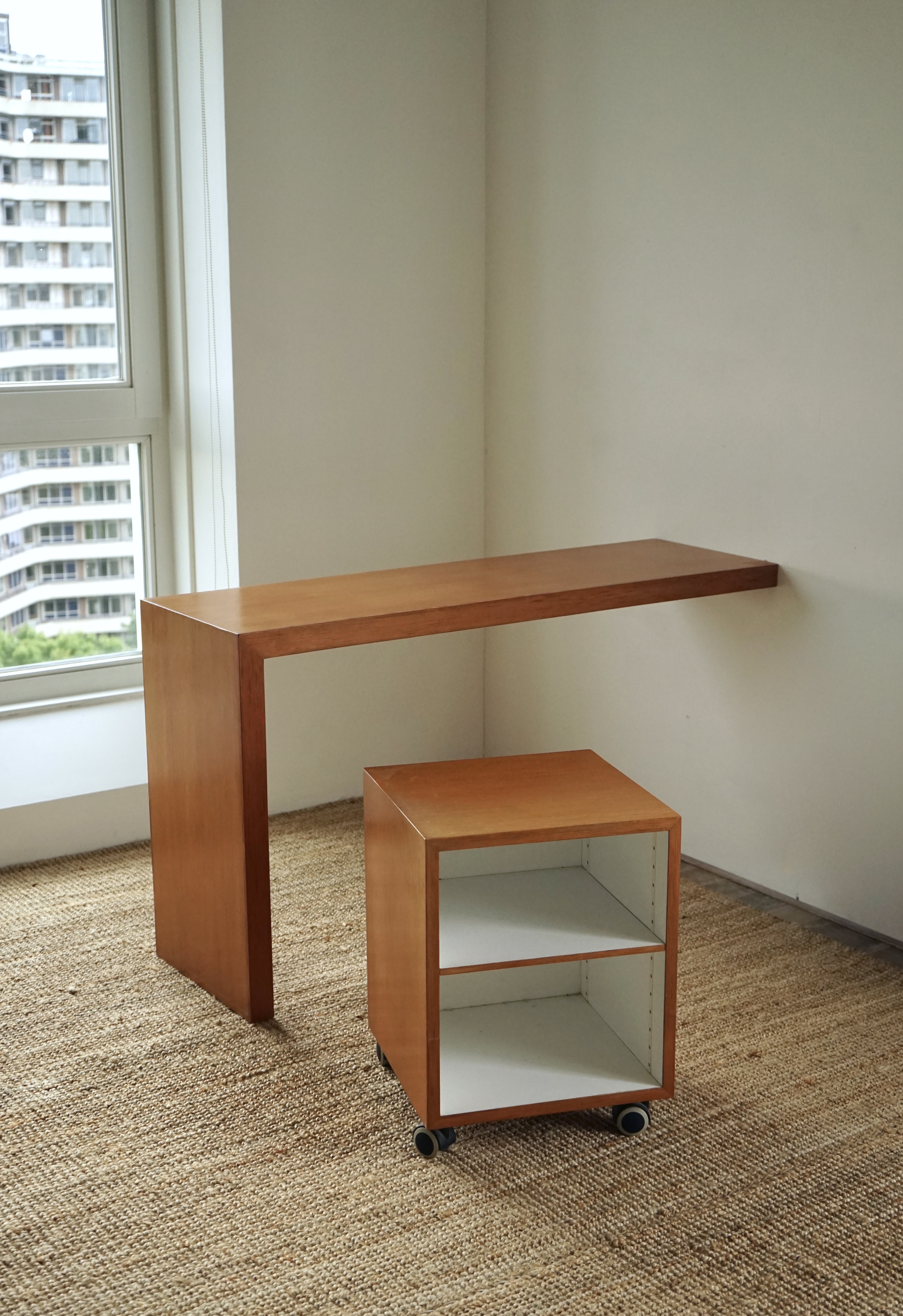
A small wall mounted oregon pine desk (ladies desk) with accompanying drawer unit.
128 x 39.5 x 72cm high
Designed and made to commission for a private residence in Laren, NL in the 1960s (Like much of den Boon’s work this item documented at the Het Nieuwe Instituut, Rotterdam). It was initially designed to work as a vanity unit, although nowadays can be used as a neat little desk.
Purchased from its initial owner who commissioned it amongst other furniture specifically for their home.
Between the 1950s & 60s, Dutch designer and architect Wim den Boon was at the height of his powers. His success alongside other designers as ‘Group &’ (including Hein Stolle, etc.) and later with Goed Wonen lay in the fact that his purist design of the interiors and furniture fitted in seamlessly with the functionalist design of the late thirties. (Goed Wonen was a foundation and leading magazine formed after the war with the aim of “raising the standard of living in the Netherlands by improving home furnishings in the broadest sense of the word…”)
Den Boon wrote several articles for Goed Wonen – His articles are almost without exception educational, presenting readers sometimes quite forcibly with the liberating nature of the new design. His polemical character, stubbornness, and especially the strongly didactic tone of his articles was too much for many employees and readers of Goed Wonen and in 1950 the editors forced him to resign. It was also around 1950 that he broke his relationship with ‘Groep &’ and established himself as an independent interior designer in The Hague. From then on, his interior designs are increasingly characterised by a very careful treatment of the space that can be very strict, deliberate, and sober but also highly refined. Throughout this golden period of the 50s-60s, an extensive oeuvre was created, varying from small renovations and furniture designs to complete new construction projects for private individuals such as those who commissioned this piece.
This is a unique piece of Dutch mid-century modern design history (please note that we are also selling other items that came out of the same house)
Minor superficial wear and tear. A scratch to the top of the drawer unit and some minor discolouring.
Price: 1.450 euro
http://www.merzbaufurniture.com