Rare set of classic Scandinavian modernist stools. These three-legged stacking stools have a superb colour and patina. One stool has its Finmar label (writing has worn off) and on one stool it can be seen that there was once a label (the other two do not have labels).
Table: 130 x 78 x 74cm high Benches: 124 x 42 x 43cm high
Two long benches and table by renowned Swedish design Gilbert Marklund. The table is the rarer larger version of the design that can seat up to four people.
The desirable aspect of this set is that it is in unrestored condition with all its original patina. (The table has a few ring and burn marks to the top).
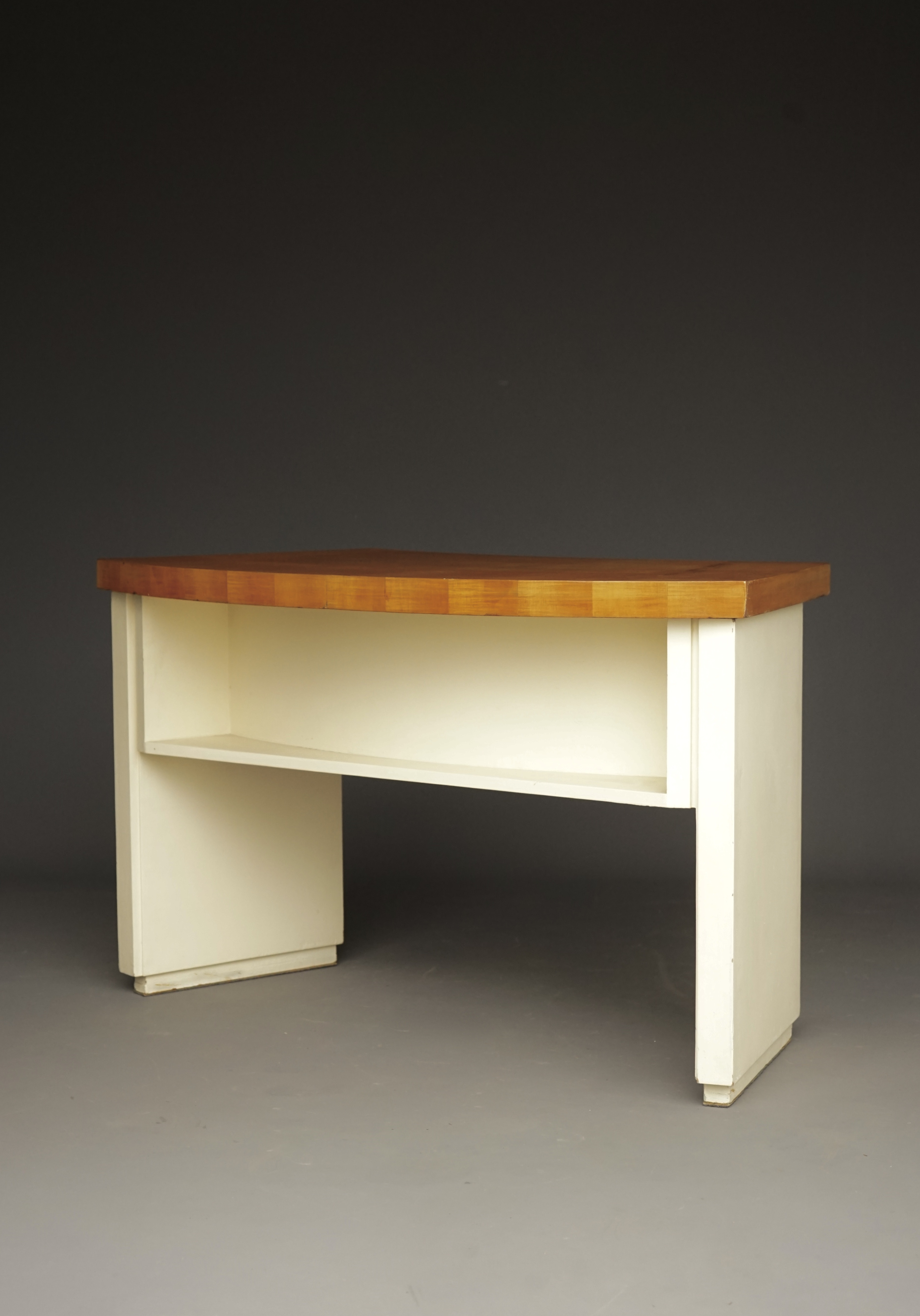
Dutch oak constructivist table. A simple designed small side table (or desk) that combines classical and geometric block components to form a bold design table with quite an architectural feel to it.
There are some old marks and patina from years of use, but overall it is in good solid condition.
Jan Slothouber & William Graatsma (NL. Mid-c20th) Five original modular cubes from the 1970s. Laminated plywood. . The Dutch duo Slothouber & Graatsma established themselves from the 1950s as artist/designers with the cube form as their key motif around which they developed various principles of cubic construction alongside multiples and variations thereof. Despite its restrictions they admired the cube for its clarity of form. They applied their thinking around it to a variety of objects, and artworks from small jewellery-scale 3d models and games to larger installation works. Highly driven personalities, they considered themselves as discoverers of ‘the many applications of the democratic system of cubics’; a system that would ostensively act to counter the rise of the expressive individualism in post-WWII culture. (They later established the CCC_the Center for Cubic Constructions as a forum for promoting their ideas). Due to their diverse and multidisciplinary output they were never to become global names – But they were a highly respected creative team (representing The Netherlands at the Venice Biennale in 1970) and in 1965 the Stedelijk Museum in Amsterdam honoured them with the exhibition ‘Vier kanten: maat, vorm, kleur, letter’ (Four sides: size, form, colour, letter). Donald Judd for one was a great admirer of their work.
Plywood No.1 table/stool with its accompanying circular tray. Manufactured by Luterma. Both stool and tray are stamped/labelled Venesta.
The British furniture entrepreneur Jack Pritchard managed Venesta the import company for Luterma in England who later formed the Isokon furniture company which most notably employed Marcel Breuer. These tables/stools were distributed in England post 1933 until 1939 exclusively by Isokon alongside designs by Marcel Breuer and Egon Riss.
Although the designer of the stool remains anonymous, in 2004 the art historian Alastair Grieve described a modification of the original Luterma stool (of which this stool is one) when he wrote that the original design was subsequently re-designed by the architect and founder of the Bauhaus Walter Gropius (hired as a consultant to Isokon). The very slight alterations Gropius made was to include sharper curves to the cut-out squares of the stool. Gropius’s drawings for the redesign can reportedly be found in the collection of the V&A Museum, London.
The separate tray placed on top of the stool is unusual and rare in that it is much thinner than all other trays we have seen. This has led to some minor warping over time (which may have been why it was produced later with a thicker rim?) The thinner rimmed tray may suggest that this was an early production or at the least a more limited production?
h.46.5cm x w.44cm x d.44cm
Literature:-
Kermik, Juri (2004) The Luther factory: Plywood and furniture 1877-1940
Daybelge & Englund, (2019); Isokon and the Bauhaus in Britain
Pritchard, Jack (1984); View from a Long Chair: The Memoirs of Jack Pritchard