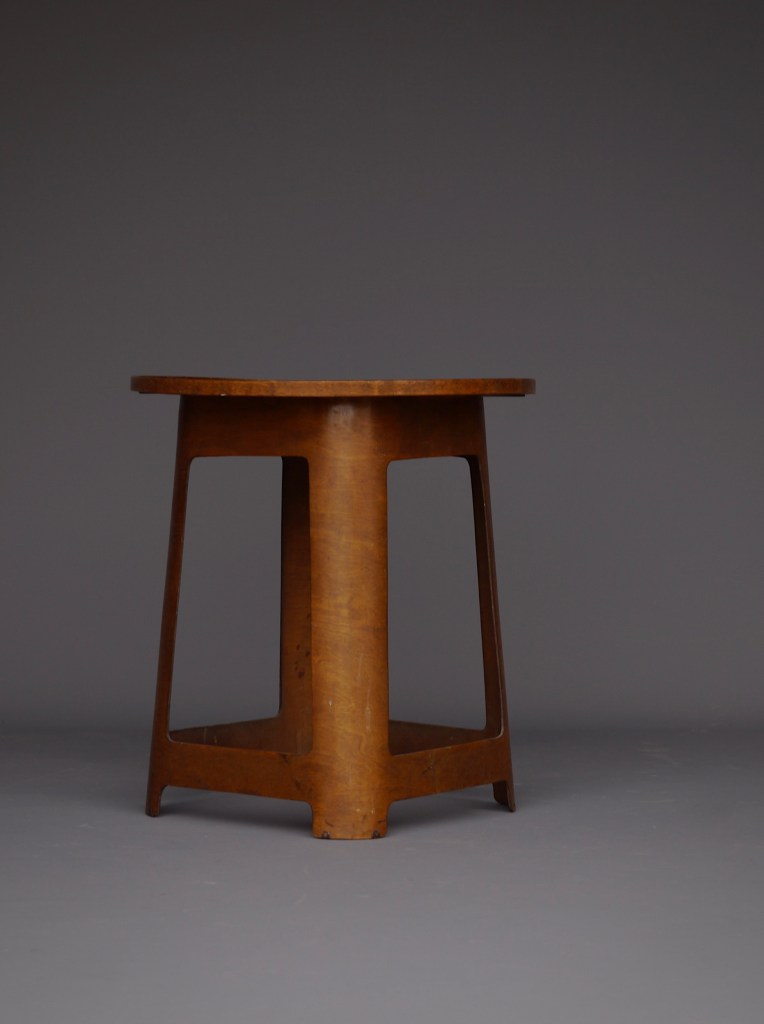
Plywood No.1 table/stool with its accompanying circular tray. Manufactured by Luterma. Both stool and tray are stamped/labelled Venesta.
The British furniture entrepreneur Jack Pritchard managed Venesta the import company for Luterma in England who later formed the Isokon furniture company which most notably employed Marcel Breuer. These tables/stools were distributed in England post 1933 until 1939 exclusively by Isokon alongside designs by Marcel Breuer and Egon Riss.
Although the designer of the stool remains anonymous, in 2004 the art historian Alastair Grieve described a modification of the original Luterma stool (of which this stool is one) when he wrote that the original design was subsequently re-designed by the architect and founder of the Bauhaus Walter Gropius (hired as a consultant to Isokon). The very slight alterations Gropius made was to include sharper curves to the cut-out squares of the stool. Gropius’s drawings for the redesign can reportedly be found in the collection of the V&A Museum, London.
The separate tray placed on top of the stool is unusual and rare in that it is much thinner than all other trays we have seen. This has led to some minor warping over time (which may have been why it was produced later with a thicker rim?) The thinner rimmed tray may suggest that this was an early production or at the least a more limited production?
h.46.5cm x w.44cm x d.44cm
Literature:-
Kermik, Juri (2004) The Luther factory: Plywood and furniture 1877-1940
Daybelge & Englund, (2019); Isokon and the Bauhaus in Britain
Pritchard, Jack (1984); View from a Long Chair: The Memoirs of Jack Pritchard
A large carved signed totemic form sculpture. The artist, Bertus Hylkema was born in Luinjeberd in France in 1927. He moved to Amsterdam and worked and taught there and later moved to Amersfoort. The artist died in 2004.
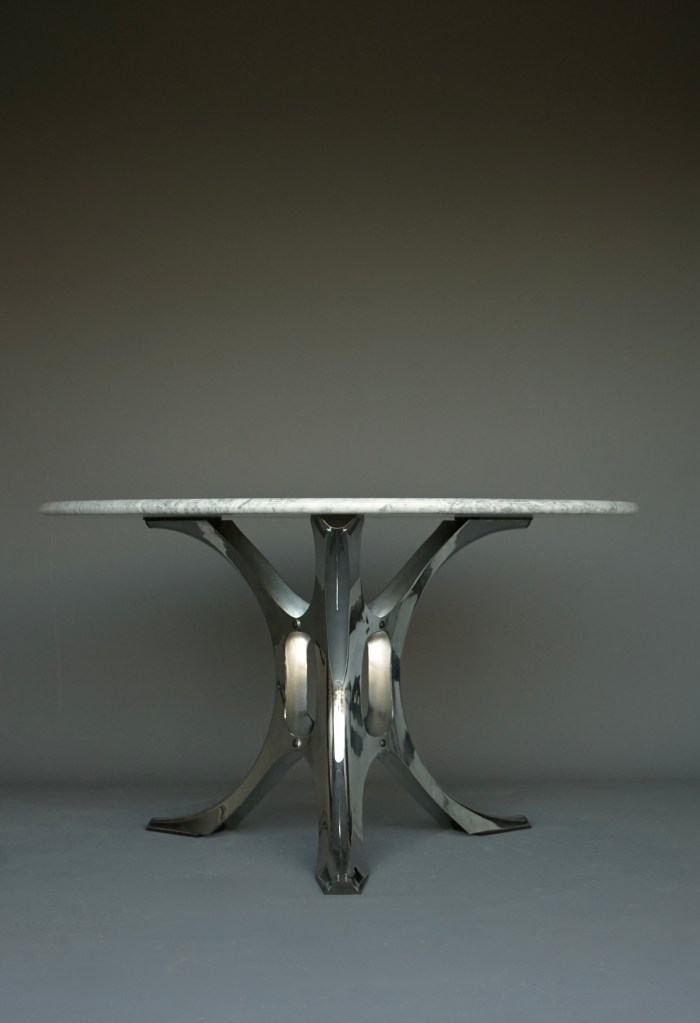
The bumper table is undoubtedly Martin Visser’s most intriguing design, the baroque translation from 1965 of his table base tz06 from the early 1960s. The development of Martin Visser’s bumper table provides insight into and understanding of his design processes: The table’s main feature is its reversible tripod base, later called ‘Abusir’ – Seemingly simple with the three points on the floor and three points to carry the top (in the history of furniture the tripod table is known to be the most stable structure).
Only two series were produced in very limited numbers due to the technical difficulties of manufacturing the base. Spectrum Furniture (‘t Spectrum) manufactured the table as several versions that varied in height, width, materials and finishes – this version with the white carrara marble top.
Brutalist / Structuralist chair. Netherlands. Circa 1960s/70s.
Steel & leather/hide.
An interesting architectural chair. Its construction and manufacture lead us to believe that it is possibly a prototype? – Its design reflects the style of post-war structuralist architecture/interiors typical of several Rotterdam architects from the period. (we are still researching the design).
A rare first steel edition of the ‘Less’ table by Jean Nouvel (later editions were in aluminium and lighter). The table was originally designed for Foundation Cartier office in Paris.
The top has a distinctive sunken underside, not seen when viewed from above – the result is the illusion of a wafer thin top supported by four thin legs.
Original lacquered surface in anthracite metallic grey/silver colour. In good condition – some minor scratches. The legs can be unscrewed from the top.
Unique bespoke table that was commissioned as part the furnishings of the Bethlehem Church built in 1979 in Breda. The church was designed by two Bossche School architects: Hans van der Laan (the nephew of Dom Hans vd Laan) together with the architect Harry van Hal. The table is solid, beautifully built and heavy. . Solid merbau wood. 175.5 x 131 x 76cm




 [merzbau]