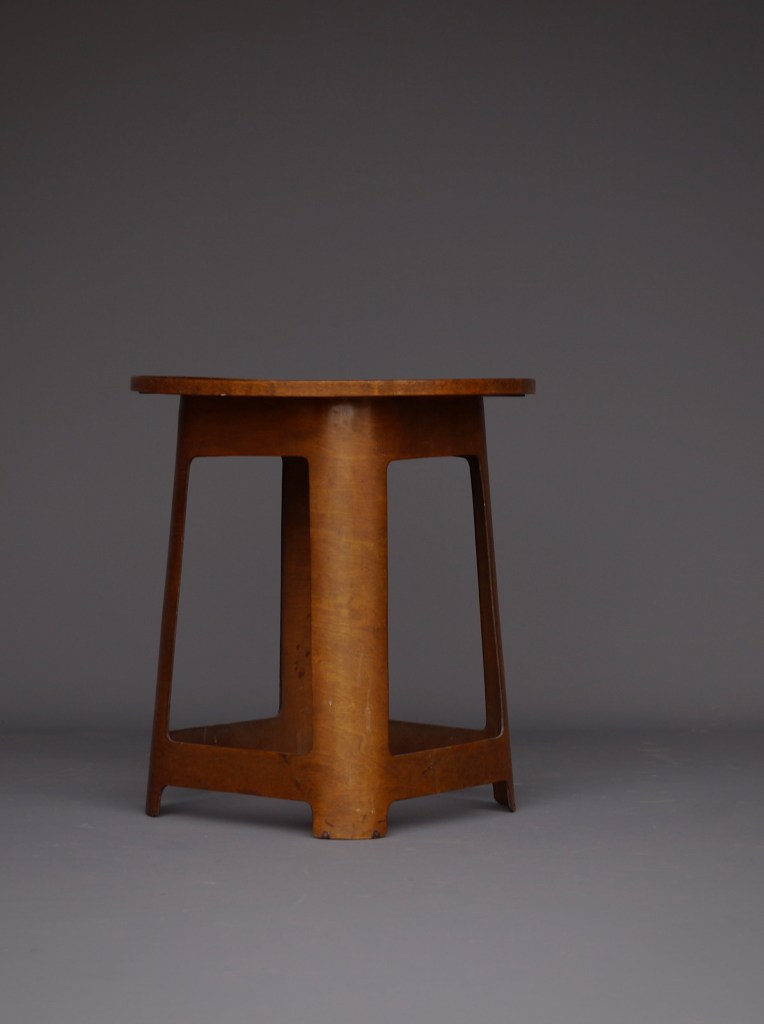
Isokon No.1 Stool

Venesta plywood table/stool for Isokon. 1930s

Plywood No.1 table/stool with its accompanying circular tray. Manufactured by Luterma. Both stool and tray are stamped/labelled Venesta.

The British furniture entrepreneur Jack Pritchard managed Venesta the import company for Luterma in England who later formed the Isokon furniture company which most notably employed Marcel Breuer. These tables/stools were distributed in England post 1933 until 1939 exclusively by Isokon alongside designs by Marcel Breuer and Egon Riss.

Although the designer of the stool remains anonymous, in 2004 the art historian Alastair Grieve described a modification of the original Luterma stool (of which this stool is one) when he wrote that the original design was subsequently re-designed by the architect and founder of the Bauhaus Walter Gropius (hired as a consultant to Isokon). The very slight alterations Gropius made was to include sharper curves to the cut-out squares of the stool. Gropius’s drawings for the redesign can reportedly be found in the collection of the V&A Museum, London.

The separate tray placed on top of the stool is unusual and rare in that it is much thinner than all other trays we have seen. This has led to some minor warping over time (which may have been why it was produced later with a thicker rim?) The thinner rimmed tray may suggest that this was an early production or at the least a more limited production?

h.46.5cm x w.44cm x d.44cm

Literature:-

  • Kermik, Juri (2004) The Luther factory: Plywood and furniture 1877-1940
  • Daybelge & Englund, (2019); Isokon and the Bauhaus in Britain
  • Pritchard, Jack (1984); View from a Long Chair: The Memoirs of Jack Pritchard

Price: 3.650 euro
http://www.merzbaufurniture.com

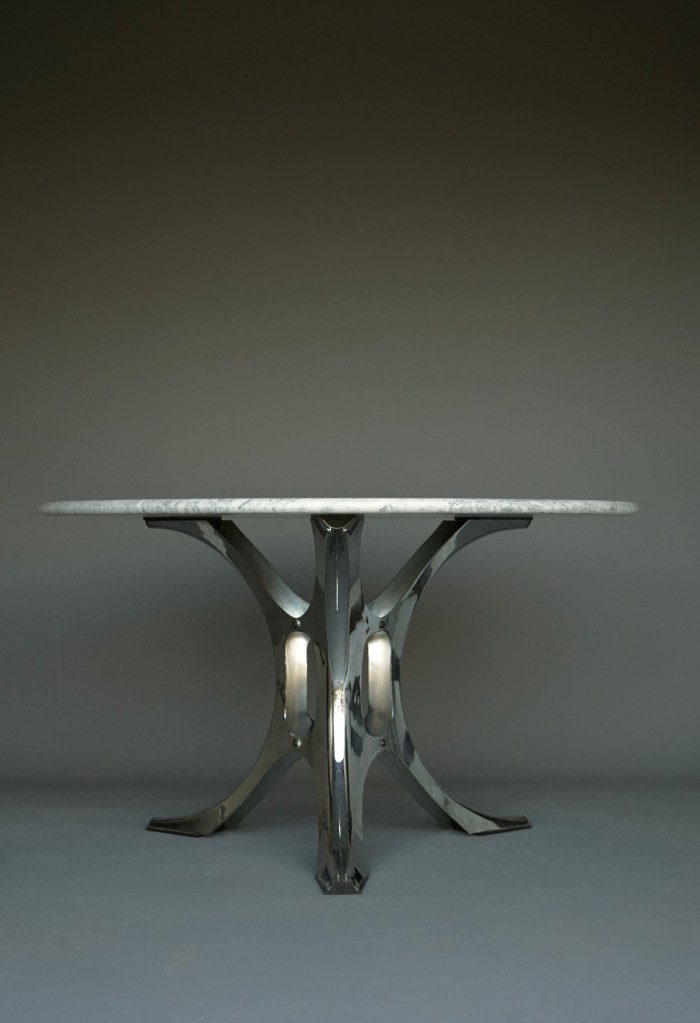
Bumper table

Martin Visser (Nl. 1922-2009)

The bumper table is undoubtedly Martin Visser’s most intriguing design, the baroque translation from 1965 of his table base tz06 from the early 1960s. The development of Martin Visser’s bumper table provides insight into and understanding of his design processes: The table’s main feature is its reversible tripod base, later called ‘Abusir’ – Seemingly simple with the three points on the floor and three points to carry the top (in the history of furniture the tripod table is known to be the most stable structure).

Only two series were produced in very limited numbers due to the technical difficulties of manufacturing the base. Spectrum Furniture (‘t Spectrum) manufactured the table as several versions that varied in height, width, materials and finishes – this version with the white carrara marble top.

Price: 14,500 euro

http://www.merzbaufurniture.com

architectural chair

Brutalist / Structuralist chair. Netherlands. Circa 1960s/70s.

Steel & leather/hide.

An interesting architectural chair. Its construction and manufacture lead us to believe that it is possibly a prototype? – Its design reflects the style of post-war structuralist architecture/interiors typical of several Rotterdam architects from the period. (we are still researching the design).

Price: 4,400 euro

http://www.merzbaufurniture.com

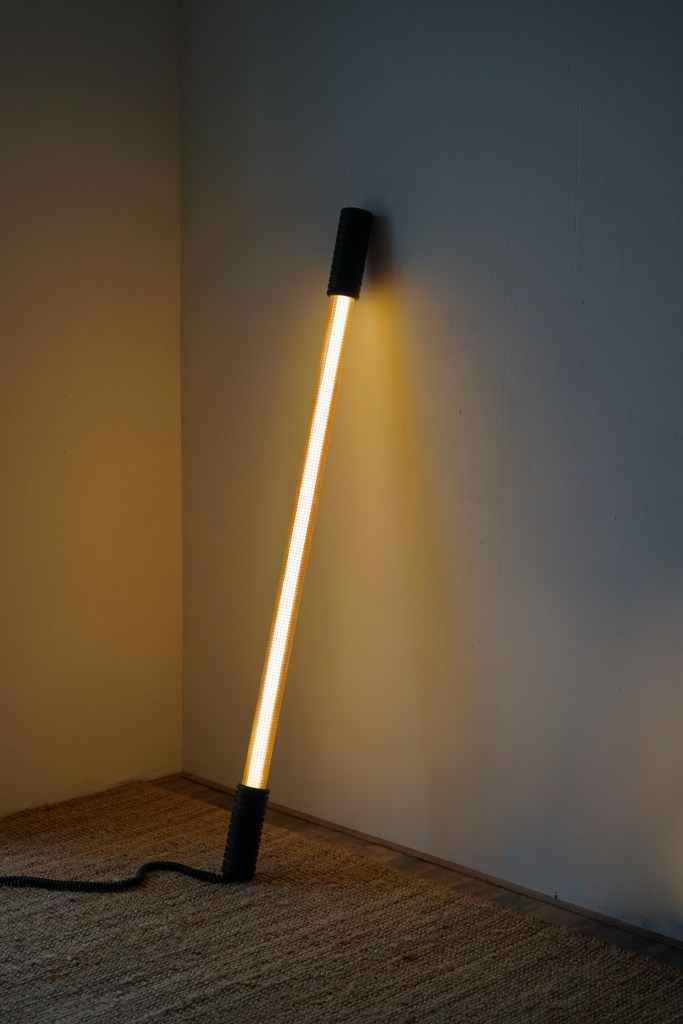
easylight

Philippe Starck (Fr. 1949-now)

Rare ‘easylight’ Electrorama, Circa 1980.

Floor-neon lamp. Designed around 1977, the edition was for Starck Product or Electrorama circa 1980. Stamped ‘Starck Product’.

Makrolon, polyurethane and fluorescent tube H: 142 cm. (56 inches); D: 6,7cm.(2 3/8in.). The lamp has an inbuilt mercury tilt switch (the lamp lights up when its position is slightly altered)

This lamp was most likely purchased in the Netherlands at De Bijenkorf, circa 1980. Bibliography: J.-F. Grunfeld, M.-L. Jousset, Lumières Je Pense à Vous, exhibition catalog, Centre Georges Pompidou, Paris, June 3-August 5, 1985, p. 158, n. 282 C. Colin, Starck, Ed Pierre Mardaga, Liège, 1988, p. 274, 278, 296

Price: 5.500 euro

http://www.merzbaufurniture.com

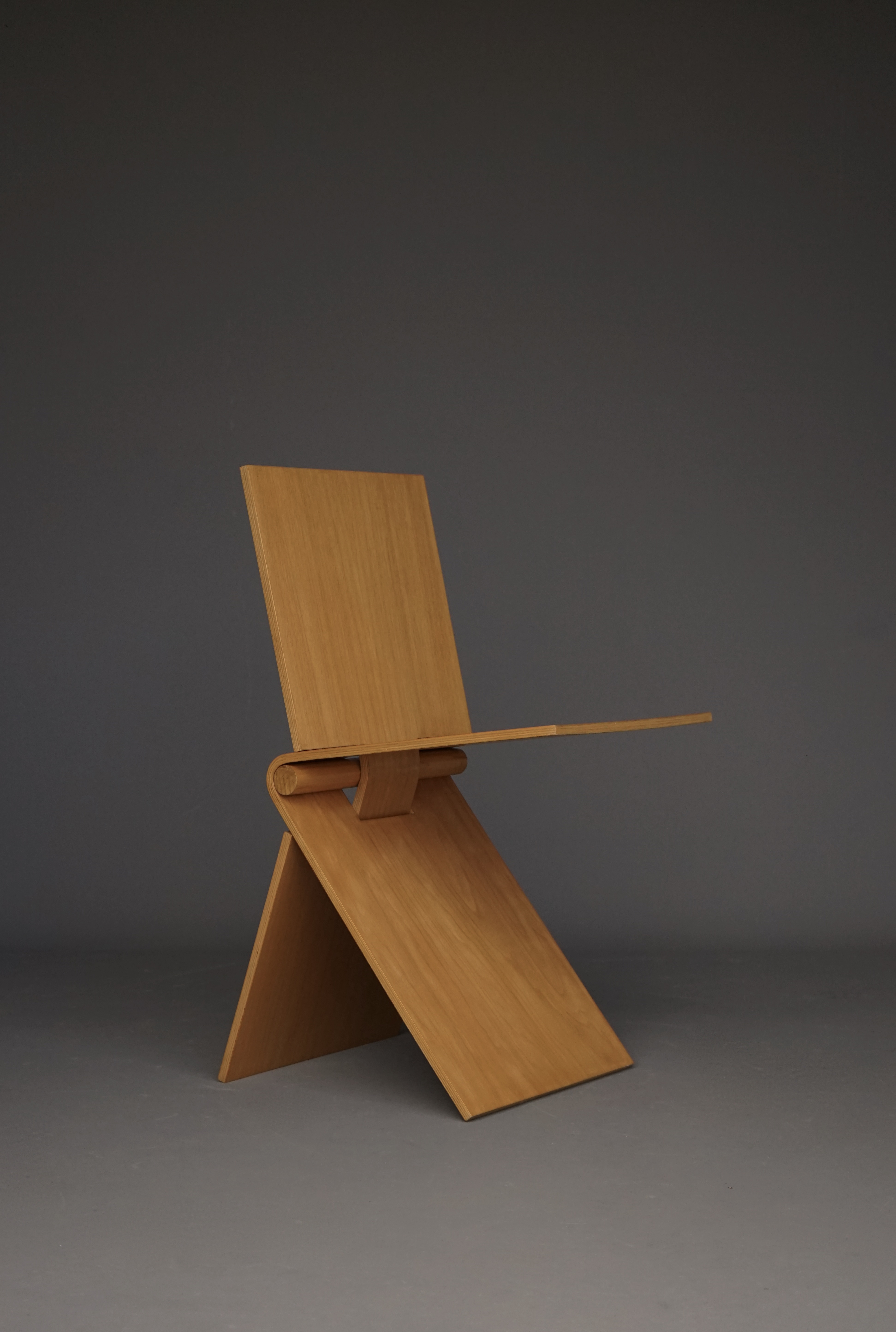
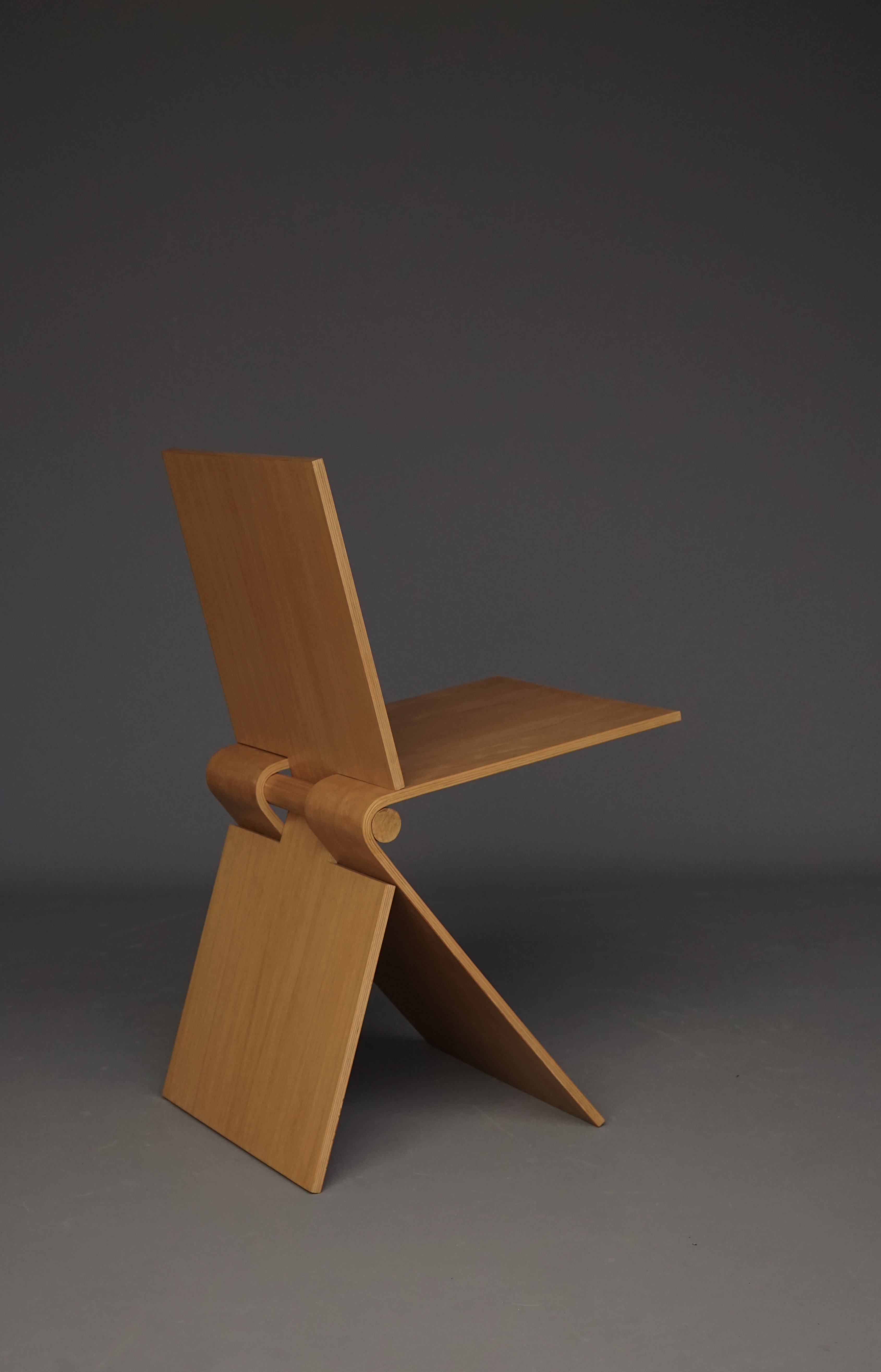
Bruno Ninaber van Eyben (NL. 1950-now)

Artifort. 1970s. Plywood.

The model 020 ‘Stick’ chair was designed by Dutch industrial designer Bruno Ninaber van Eyben in 1977.

The design is made up of three constituent parts that fit together: two pieces of angled plywood and a length of stick with a round profile. The stick in the middle connects the plywood pieces and functions as the backbone and strength of the chair.

These rare chairs were manufactured in very limited numbers due to the production costs and difficulties. Only 150 of these chairs were produced. Apart from its low production numbers the other reason that so few exist is because they can easily get damaged – Due to the stool’s fragility we recommend that it should be purchased by a design lover that appreciates its sculptural qualities rather than its functionality!

The plywood has been refinished.

Price: 3.900 euro

http://www.merzbaufurniture.com

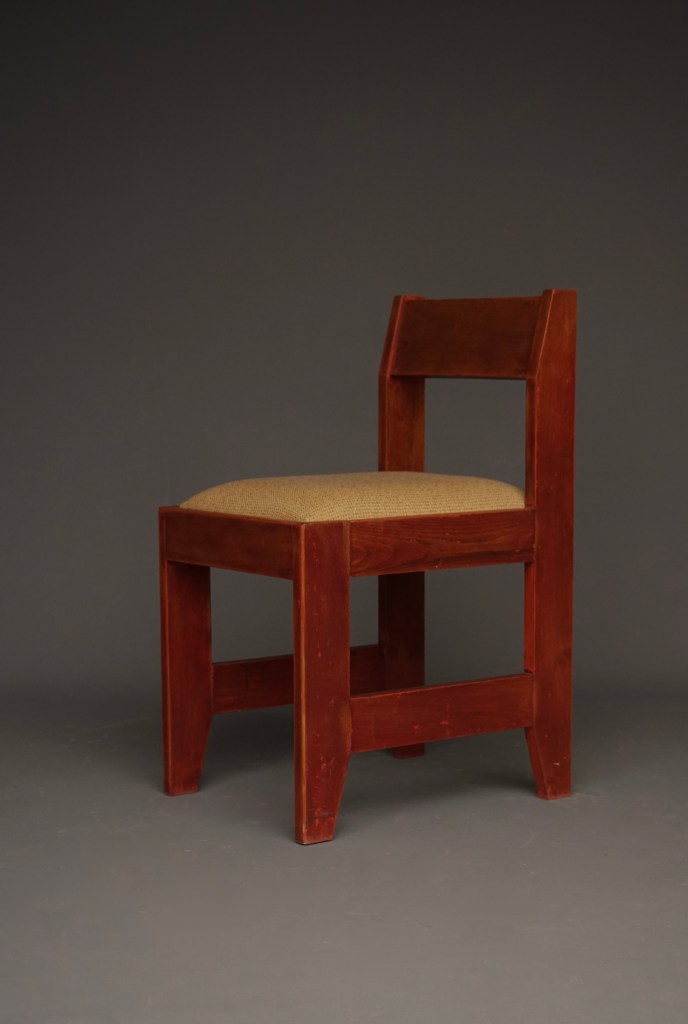
Art Deco chairs

Modernist/Art Deco side chairs.

These Dutch oak chairs in the Haagse School (Hague School) style were manufactured in the early c20th circa 1920s-30s.

Price: 1,450 euro (per piece)

http://www.merzbaufurniture.com

Modernist side chair

White-washed oak with inset strap fabric seat. Circa 1970s.

Modernist side chair with strict geometric construction.

Price: 1,450 euro

http://www.merzbaufurniture.com