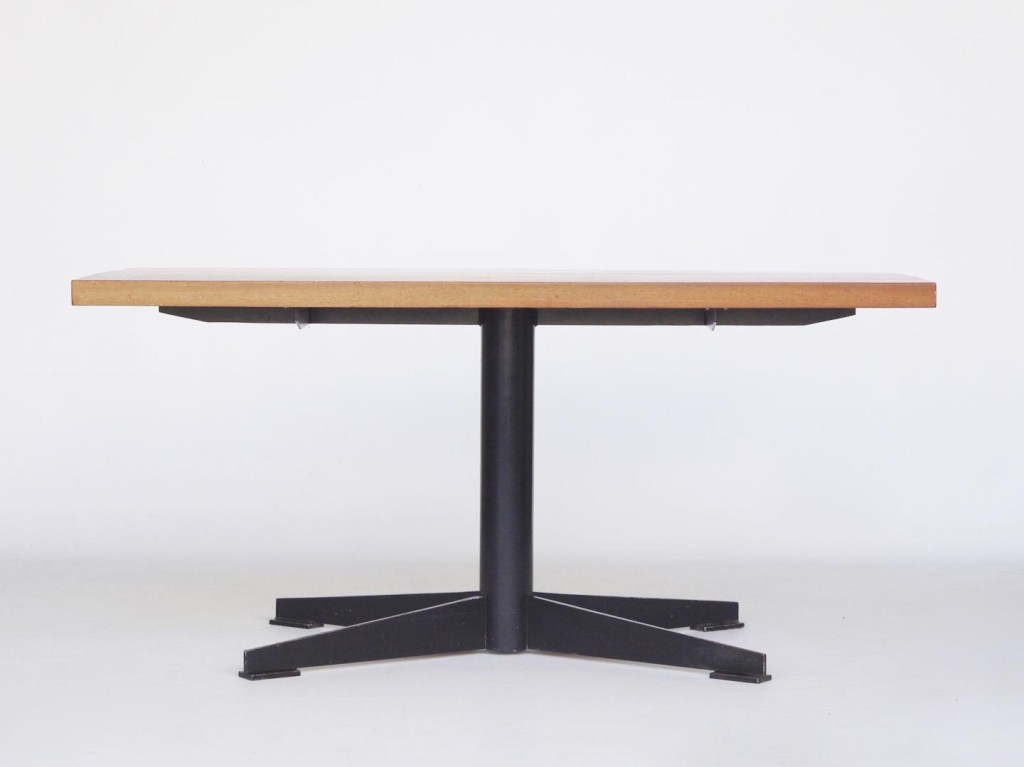
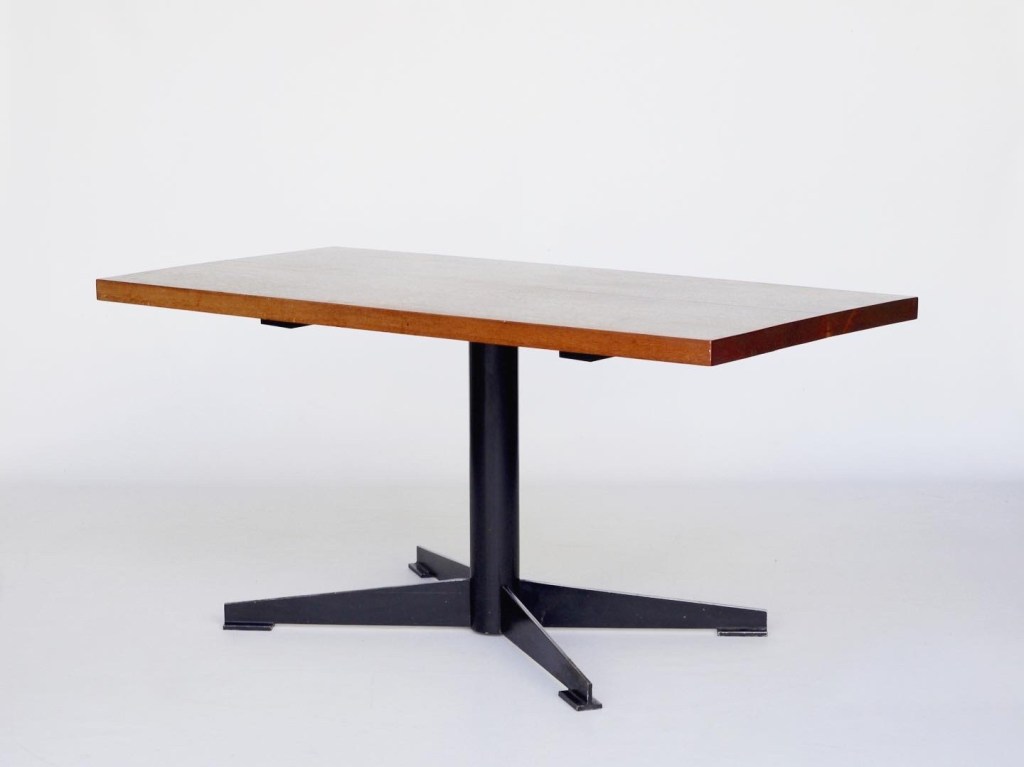
This table designed in 1950 was made for a private residence in the Netherlands. The concept and plans for the table can be found in the archive of Den Boon’s work in the NAi archives in Rotterdam.
The architect Paul Wintermans has been designing furniture primarily for architectural projects since the 1980s. This furniture was produced as unique pieces or as very limited productions. Wintermans furniture designs can be found in the collection of the Stedelijk Museum in Amsterdam.
This table is an ingenious engineered design, constructed from three separate pieces: A sheet of glass sandblasted except for two clear stripes that act both as a design feature and help position the two steel rod feet with adjustable fixings. The two feet simply lean into the structure which when combined with the weight of the glass enables the structure to clamp into place.
A console table commissioned for the adaptation of a private residence in Rotterdam during the early 1960s. It has a thick gauge steel base with a 4cm solid teak sectioned top. Den Boon was part of ‘group &’ alongside Hein Stolle and Pierre Kleykamp, a group of Dutch interior /furniture designers influenced by the reductivist designs of Gerrit Rietveld. Some provenance available including original drawing designs.
Adjustable desk lamp by Dernier & Hamlyn. The bulb section can be turned to an upright position. Original paint work (very rare colourway), although with some scorch marks to the metal in places.
BROOCH WITH SMOKY QUARTZ GEMSTONE. 1970-1974. Brooch made of silver plate with finely engraved net decoration, set with cabochon-shaped smoky quartz gemstone. Artist’s original by most famous Slovak jeweler Anton Cepka. Ag 900/1000. Total weight 140 g, length 11,6 cm, height 4,7 cm.
Compare with: H. W. Drutt English, P. Dormer, Jewelry of our time. Art, ornament and obsession, London 1995, p. 96. – Á. Schrammová: Anton Cepka – šperky a objekty, in: 53. Bulletin of Moravia Gallery in Brno, Brno 1997, p. 208-210.
A rare chair made after a commission from Bas van Pelt / The Hague. Circa 1953 for the youth hostel at Ockenberg-Kijckduin in The Netherlands.
This chair’s rudimentary but simple form and functional design typifies the spirit of the utilitarian design movement that surrounded the WWII period in Europe.




 [merzbau]